
PO02 | SYNERGISTIC INTERACTION OF ENDOTHELIAL AND CANCER CELLS IN THE FORMATION AND STRUCTURE OF THE FIBRIN CLOT SHIELDS
M.A. Baghdadi1|2, E. Mbemba1, P. Las Casa1, P. Van Dreden1|3, N. Saleem1|4, J. Fareed4, P. Kempaiah4, M. Sabbah1, G. Gerotziafas1|4 | 1Sorbonne University, INSERM UMR_S_938, CRSA, Research Department "Cancer, Vessels, Biology and Therapeutics" (CaVITE), Research Group "Cancer-Angiogenesis-Thrombosis and Haemostasis," Thrombosis Center, University Institute of Cancerology (UIC), Saint Antoine University Hospital Assistance Publique Hôpitaux de Paris (AP-HP) Paris France; 2Research Center, King Faisal Specialist Hospital and Research Center, Jeddah, Saudi Arabia; 3Diagnostica Stago, clinical research, Gennevilliers, France; 4Center of Translational Research and Education, Department of Pathology and Laboratory Medicine, Loyola University Stritch School of Medicine, Maywood, Ill., USA

All claims expressed in this article are solely those of the authors and do not necessarily represent those of their affiliated organizations, or those of the publisher, the editors and the reviewers. Any product that may be evaluated in this article or claim that may be made by its manufacturer is not guaranteed or endorsed by the publisher.
Authors
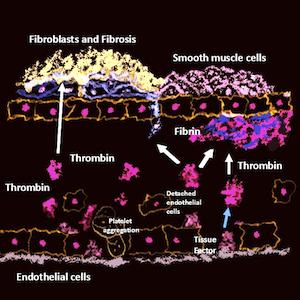
Introduction. Cancer cells (CaCe) express tissue factor (TF) and release TF-bearing extracellular vesicles (CaCe-dEVs), triggering thrombin generation and fibrin network formation within the tumor microenvironment (Tran et al., Thromb Res, 2024). Fibrin clot shields (FCS) act as protective barriers and scaffolds that support CaCe migration. FCS also exerts evolutionary pressure, selecting CaCe with increased procoagulant potential. In addition, CaCe-dEVs activate endothelial cells (EC), inducing TF expression and further enhancing local hypercoagulability.
Aim. To investigate the contribution of EC to the formation and structural characteristics of cancer cell–induced FCS and to cancer cell migration within the fibrin network.
Materials and Methods. The viability and proliferation of pancreatic cancer cells (BXPC3) and breast cancer cells (MCF7, MDA-MB-231), as well as HUVEC cultured alone or in co-culture, were assessed using the alamarBlue® assay. Cells were cultured in RPMI with 10% normal platelet-poor plasma (PPP). Co-culture experiments were performed using CaCe:EC ratios of 2:1, 1:1, and 1:2. Procoagulant activity of cells in PPP was evaluated by calibrated automated thrombography (CAT®, Diagnostica Stago). FCS architecture and CaCe invasion within the fibrin network were analyzed by scanning electron microscopy (SEM), as previously described.
Results. EC exposure to CaCe-dEVs induced a marked procoagulant shift, most pronounced with BXPC3-dEVs compared with MDA-MB-231-dEVs or MCF7-dEVs. In co-cultures, EC significantly amplified thrombin generation compared with CaCe alone. SEM analysis showed cell-dependent differences in FCS: BXPC3 formed dense networks with thin fibers, small pores, and long fibers, whereas MCF7 and MDA-MB-231 generated looser structures. EC co-culture induced cell-specific remodeling, with thicker and less complex fibers in BXPC3, increased network complexity in MDA-MB-231, and enhanced intersections and fiber length in MCF7. CaCe migrated within the fibrin network and formed distant colonies, confirming fibrin-guided invasion.
Conclusions. Cancer cells “educate” EC to acquire a potent procoagulant phenotype, amplifying thrombin generation and promoting the formation of robust FCS. EC co-culture does not impair cancer cell migration or colony formation within the fibrin network. These findings identify endothelial cell education as an additional mechanism enhancing FCS formation and contributing to FCS-mediated cancer cell resistance and migration.
Downloads
Citations




How to Cite

This work is licensed under a Creative Commons Attribution-NonCommercial 4.0 International License.