Proceedings of the 13th International Conference on Thrombosis and Hemostasis Issues in Cancer, 2026

Hormones, cancer, and thrombosis: sex-specific mechanisms at the interface of hemostasis and vascular biology

Publisher's note
All claims expressed in this article are solely those of the authors and do not necessarily represent those of their affiliated organizations, or those of the publisher, the editors and the reviewers. Any product that may be evaluated in this article or claim that may be made by its manufacturer is not guaranteed or endorsed by the publisher.
Published: 16 April 2026
0
Views
0
Downloads

Authors

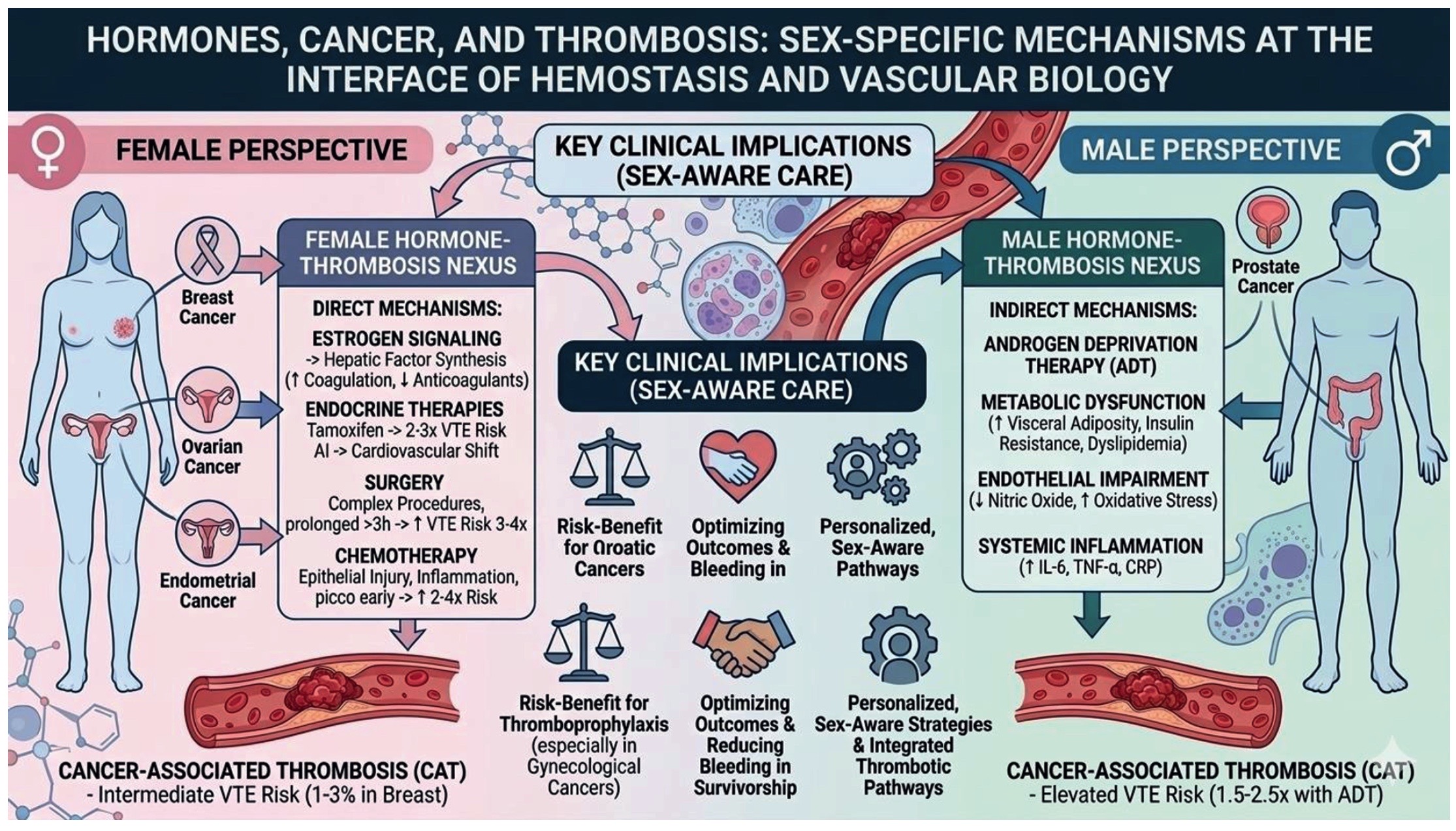
This review examines the complex relationship between hormonal signaling, cancer biology, and thrombosis, focusing primarily on cancer-associated venous thromboembolism (VTE) in hormone-sensitive malignancies. Hormones regulate key hemostatic processes—including coagulation, platelet activity, endothelial function, and fibrinolysis—and disturbances in these pathways can promote thrombotic complications in patients with cancer. Sex hormones play distinct roles in modulating thrombotic risk. Estrogens tend to promote a prothrombotic state by increasing procoagulant factors and reducing anticoagulant activity, whereas progesterone has minimal direct hemostatic effects. The impact of testosterone remains less clear, although some data suggest a transient increase in VTE risk shortly after initiation of testosterone therapy. In hormone-dependent cancers, endocrine therapies further modify thrombotic risk through their effects on hormonal pathways and tumor-associated inflammation. The magnitude and mechanisms of thrombosis vary across malignancies. In breast cancer, VTE risk is generally moderate but increases with age, obesity, disease stage, chemotherapy, and particularly endocrine therapy such as tamoxifen, which is associated with a two- to three-fold higher VTE risk. Ovarian cancer is among the most thrombogenic solid tumors, driven by tumor biology, inflammatory activation, and intensive treatments such as surgery and platinum-based chemotherapy. Endometrial cancer risk is linked to prolonged estrogen exposure and obesity, while prostate cancer demonstrates increased thrombotic risk primarily related to androgen deprivation therapy, which induces metabolic and vascular changes that favor hypercoagulability. These sex-specific differences highlight the need for risk-adapted strategies for thromboprophylaxis and surveillance. Clinical management should consider tumor type, hormonal environment, treatment modality, and patient-specific risk factors. As survival improves in hormone-sensitive cancers, optimizing prevention of thrombotic complications while minimizing bleeding risk represents an important component of personalized oncologic care.

Graphical Abstract
mceclip0-dfda15fa611cf7baf248ca2f8639124f.jpg


Downloads

Download data is not yet available.

Citations

1. Muralikrishnan AS, Biasin V, Zabini D, Osto E. Immune and vascular function in cardiometabolic disorders: interplay with sex differences and impact on incretin therapy. Acta Physiol (Oxf) 2025;241:e70091. DOI: https://doi.org/10.1111/apha.70091
2. Sharma BK, Flick MJ, Palumbo JS. Cancer-associated thrombosis: a two-way street. Semin Thromb Hemost 2019;45:559-568. DOI: https://doi.org/10.1055/s-0039-1693472
3. Okwuosa TM, Morgans A, Rhee JW, et al. Impact of hormonal therapies for treatment of hormone-dependent cancers (breast and prostate) on the cardiovascular system: effects and modifications: a scientific statement from the American Heart Association. Circ Genom Precis Med 2021;14:e000082. DOI: https://doi.org/10.1161/HCG.0000000000000082
4. Nordstrom SM, Weiss EJ. Sex differences in thrombosis. Expert Rev Hematol 2008;1:3-8. DOI: https://doi.org/10.1586/17474086.1.1.3
5. Barcellona D, Grandone E, Marongiu F. Hormones and thrombosis: the dark side of the moon. Blood Transfus 2024;22:46-54.
6. Hansda S, Das H. Insights into cancer-associated thrombosis leading towards ischemic stroke. Biology (Basel) 2025;14:50. DOI: https://doi.org/10.3390/biology14010050
7. Nadir Y, Brenner B. Cancer and thrombosis-New insights. Rambam Maimonides Med J 2018;9:1-7. DOI: https://doi.org/10.5041/RMMJ.10349
8. Houghton DE, Alsawas M, Barrioneuvo P, et al. Testosterone therapy and venous thromboembolism: A systematic review and meta-analysis. Thromb Res 2018;172:94-103. DOI: https://doi.org/10.1016/j.thromres.2018.10.023
9. Walker RF, Zakai NA, MacLehose RF, et al. Association of testosterone therapy with risk of venous thromboembolism among men with and without hypogonadism. JAMA Intern Med 2020;180:190–197. DOI: https://doi.org/10.1001/jamainternmed.2019.5135
10. Miziak P, Baran M, Błaszczak E, et al. Estrogen receptor signaling in breast cancer. Cancers (Basel) 2023;15:4689. DOI: https://doi.org/10.3390/cancers15194689
11. Saatci O, Huynh-Dam KT, Sahin O. Endocrine resistance in breast cancer: from molecular mechanisms to therapeutic strategies. J Mol Med (Berl) 2021;99:1691-1710. DOI: https://doi.org/10.1007/s00109-021-02136-5
12. Quistini A, Chierigo F, Fallara G, et al. Androgen Receptor Signalling in Prostate Cancer: Mechanisms of Resistance to Endocrine Therapies. Res Rep Urol 2025;17:211-223. DOI: https://doi.org/10.2147/RRU.S388265
13. Abou-Ismail MY, Citla Sridhar D, Nayak L. Estrogen and thrombosis: A bench to bedside review. Thromb Res 2020;192:40-51. DOI: https://doi.org/10.1016/j.thromres.2020.05.008
14. Blondon M, Bodmer A, Thouvenin L, et al. Differential impact of tamoxifen and aromatase inhibitors on thrombin generation: the prospective HEMOBREAST cohort. Blood Adv 2022;6:2884-2892. DOI: https://doi.org/10.1182/bloodadvances.2021006623
15. Łukasiewicz S, Czeczelewski M, Forma A, et al. Breast cancer-epidemiology, risk factors, classification, prognostic markers, and current treatment strategies-An updated review. Cancers (Basel) 2021;13:4287. DOI: https://doi.org/10.3390/cancers13174287
16. Horsted F, West J, Grainge MJ. Risk of venous thromboembolism in patients with cancer: a systematic review and meta-analysis. PLoS Med 2012;9:e1001275. DOI: https://doi.org/10.1371/journal.pmed.1001275
17. Razouki ZA, Ali NT, Nguyen VQ, Escalante CP. Risk factors associated with venous thromboembolism in breast cancer: a narrative review. Support Care Cancer 2022;30:8589-8597. DOI: https://doi.org/10.1007/s00520-022-07045-y
18. Donnellan E, Khorana AA. Cancer and venous thromboembolic disease: a review. Oncologist 2017;22:199-207. DOI: https://doi.org/10.1634/theoncologist.2016-0214
19. Lyman GH, Carrier M, Ay C, et al. American Society of Hematology 2021 guidelines for management of venous thromboembolism: prevention and treatment in patients with cancer. Blood Adv 2021;5:927-974. DOI: https://doi.org/10.1182/bloodadvances.2021004734
20. Dickmann B, Ahlbrecht J, Ay C, et al. Regional lymph node metastases are a strong risk factor for venous thromboembolism: results from the Vienna Cancer and Thrombosis Study. Haematologica 2013;98:1309-14. DOI: https://doi.org/10.3324/haematol.2012.073338
21. Maesaka JY, Reis YN, Elias LM, et al. Venous thromboembolism incidence in postoperative breast cancer patients. Clinics (Sao Paulo) 2023;78:100229. DOI: https://doi.org/10.1016/j.clinsp.2023.100229
23. Dhannoon A, Balasubramanian I, Dhannoon AA, et al. The Risk of Haematoma and Venous Thrombosis Associated With Thromboprophylaxis Use in Breast Cancer Surgery: A Meta-Analysis and Systematic Review. Breast J 2025;2025:9898596. DOI: https://doi.org/10.1155/tbj/9898596
24. Gervaso L, Dave H, Khorana AA. Venous and arterial thromboembolism in patients with cancer: JACC: CardioOncology state-of-the-art review. JACC CardioOncol 2021;3:173-190. DOI: https://doi.org/10.1016/j.jaccao.2021.03.001
25. van Hylckama Vlieg MAM, Nasserinejad K, Visser C, et al. The risk of recurrent venous thromboembolism after discontinuation of anticoagulant therapy in patients with cancer-associated thrombosis: a systematic review and meta-analysis. EClinicalMedicine 2023;64:102194. DOI: https://doi.org/10.1016/j.eclinm.2023.102194
26. Vladić N, Englisch C, Berger JM, et al. Validation of risk assessment models for venous thromboembolism in patients with cancer receiving systemic therapies. Blood Adv 2025;9:3340-3349. DOI: https://doi.org/10.1182/bloodadvances.2025016044
27. Key NS, Khorana AA, Kuderer NM, et al. Venous thromboembolism prophylaxis and treatment in patients with cancer: ASCO Guideline Update. J Clin Oncol 2023;41:3063-71.
28. Falanga A, Ay C, Di Nisio M, et al. Venous thromboembolism in cancer patients: ESMO Clinical Practice Guideline. Ann Oncol 2023;34:452-67. DOI: https://doi.org/10.1016/j.annonc.2022.12.014
29. Decensi A, Maisonneuve P, Rotmensz N, et al. Effect of tamoxifen on venous thromboembolic events in a breast cancer prevention trial. Circulation 2005; 111:650-6. DOI: https://doi.org/10.1161/01.CIR.0000154545.84124.AC
30. Sánchez Cánovas M, López Robles J, Adoamnei E, et al. Thrombosis in breast cancer patients on cyclin-dependent kinase inhibitors: Survival impact and predictive factors - A study by the cancer and thrombosis group of the Spanish society of medical oncology (SEOM). Eur J Intern Med 2024;130:98-105. DOI: https://doi.org/10.1016/j.ejim.2024.08.005
31. Verso M, Moik F, Graziani M, Cohen AT. Targeted anti-cancer agents and risk of venous thromboembolism. Haematologica 2024;109:3868-78. DOI: https://doi.org/10.3324/haematol.2023.284778
32. Kowalczyk L, Bartsch R, Singer CF, et al. Adverse Events of trastuzumab emtansine (T-DM1) in the treatment of HER2-positive breast cancer patients. Breast Care (Basel) 2017;12:401-8. DOI: https://doi.org/10.1159/000480492
33. Kubo-Kaneda M, Hirota H, Kotaka S, et al. Symptomatic and asymptomatic venous thromboembolism after minimally invasive surgery for gynecological cancers. J Obstet Gynaecol Res 2025;51:e70054. DOI: https://doi.org/10.1111/jog.70054
34. Sebastián OG, Trujillo-Santos J, Díaz-Pedroche MDC, et al. Venous thromboembolism in patients with breast, ovarian, and uterine cancer. A comparative analysis from the Registro Informatizado Enfermedad TromboEmbólica registry. Res Pract Thromb Haemost 2025;10:103301. DOI: https://doi.org/10.1016/j.rpth.2025.103301
35. Wun T, White RH. Epidemiology of cancer-related venous thromboembolism. Best Pract Res Clin Haematol 2009;22:9-23. DOI: https://doi.org/10.1016/j.beha.2008.12.001
36. Bakhru A. Effect of ovarian tumor characteristics on venous thromboembolic risk. J Gynecol Oncol 2013;24:52-8. DOI: https://doi.org/10.3802/jgo.2013.24.1.52
37. Streiff MB. Thrombosis in the setting of cancer. Hematology Am Soc Hematol Educ Program 2016;2016:196-205. DOI: https://doi.org/10.1182/asheducation-2016.1.196
38. Walker AJ, Card TR, West J, Crooks C, Grainge MJ. Incidence of venous thromboembolism in patients with cancer - a cohort study using linked United Kingdom databases. Eur J Cancer 2013;49:1404-13. DOI: https://doi.org/10.1016/j.ejca.2012.10.021
39. Kröger K, Weiland D, Ose C, et al. Risk factors for venous thromboembolic events in cancer patients. Ann Oncol 2006;17:297-303. DOI: https://doi.org/10.1093/annonc/mdj068
40. Poenou G, Corbaux P, Accassat S, et al. Venous thromboembolism in women with breast and gynaecological cancers: what do we know and what should we do? Clin Appl Thromb Hemost 2026;32:10760296251415374. DOI: https://doi.org/10.1177/10760296251415374
41. Obeagu EI. Venous thromboembolism in ovarian cancer: pathophysiology, risk, and management. Ann Med Surg (Lond) 2025;87:8587-8596. DOI: https://doi.org/10.1097/MS9.0000000000004192
42. Falanga A, Lorusso D, Colombo N, et al. Gynecological cancer and venous thromboembolism: a narrative review to increase awareness and improve risk assessment and prevention. Cancers (Basel) 2024;16:1769. DOI: https://doi.org/10.3390/cancers16091769
43. Guo Z, Huang Y, Gong L, et al. Association of androgen deprivation therapy with thromboembolic events in patients with prostate cancer: a systematic review and meta-analysis. Prostate Cancer Prostatic Dis 2018; 21:451-60. DOI: https://doi.org/10.1038/s41391-018-0059-4
44. Quagliariello V, Berretta M, Bisceglia I, et al. In the era of cardiovascular-kidney-metabolic syndrome in cardio-oncology: from pathogenesis to prevention and therapy. Cancers (Basel) 2025;17:1169. DOI: https://doi.org/10.3390/cancers17071169
45. Młynarska E, Bojdo K, Frankenstein H, et al. Endothelial dysfunction as the common pathway linking obesity, hypertension and atherosclerosis. Int J Mol Sci 2025;26:10096. DOI: https://doi.org/10.3390/ijms262010096
46. Lip GY, Chin BS, Blann AD. Cancer and the prothrombotic state. Lancet Oncol 2002;3:27-34. DOI: https://doi.org/10.1016/S1470-2045(01)00619-2
47. Blondon M, Righini M. Excess risk of venous thromboembolism associated with androgen deprivation therapy. Eur Urol 2016; 70:62-3. DOI: https://doi.org/10.1016/j.eururo.2016.01.001
48. O'Farrell S, Sandström K, Garmo H, et al. Risk of thromboembolic disease in men with prostate cancer undergoing androgen deprivation therapy. BJU Int 2016;118:391-8. DOI: https://doi.org/10.1111/bju.13360
49. Kulkarni AA, Rubin N, Tholkes A, et al. Risk for stroke and myocardial infarction with abiraterone versus enzalutamide in metastatic prostate cancer patients. ESMO Open 2021;6:100261. DOI: https://doi.org/10.1016/j.esmoop.2021.100261
50. Hernandez RK, Sørensen HT, Pedersen L, et al. Tamoxifen treatment and risk of deep venous thrombosis and pulmonary embolism: a Danish population-based cohort study. Cancer 2009;115:4442-9. DOI: https://doi.org/10.1002/cncr.24508
51. Key NS, Khorana AA, Kuderer NM, et al. Venous thromboembolism prophylaxis and treatment in patients with cancer: ASCO Guideline Update. J Clin Oncol 2023;41:3063-71. DOI: https://doi.org/10.1200/JCO.23.00294

Supporting Agencies

European Union under the Horizon Europe Innovation Action ThrombUS

How to Cite


1.
Grandone E, Tiscia G. Hormones, cancer, and thrombosis: sex-specific mechanisms at the interface of hemostasis and vascular biology. Bleeding Thromb Vasc Biol [Internet]. 2026 Apr. 16 [cited 2026 Apr. 17];5(s1). Available from: https://www.btvb.org/btvb/article/view/435

Most read articles by the same author(s)