Reviews

Cardiovascular risk in hormone replacement therapy

Publisher's note
All claims expressed in this article are solely those of the authors and do not necessarily represent those of their affiliated organizations, or those of the publisher, the editors and the reviewers. Any product that may be evaluated in this article or claim that may be made by its manufacturer is not guaranteed or endorsed by the publisher.
Published: 9 February 2026
1276
Views
241
Downloads

Authors

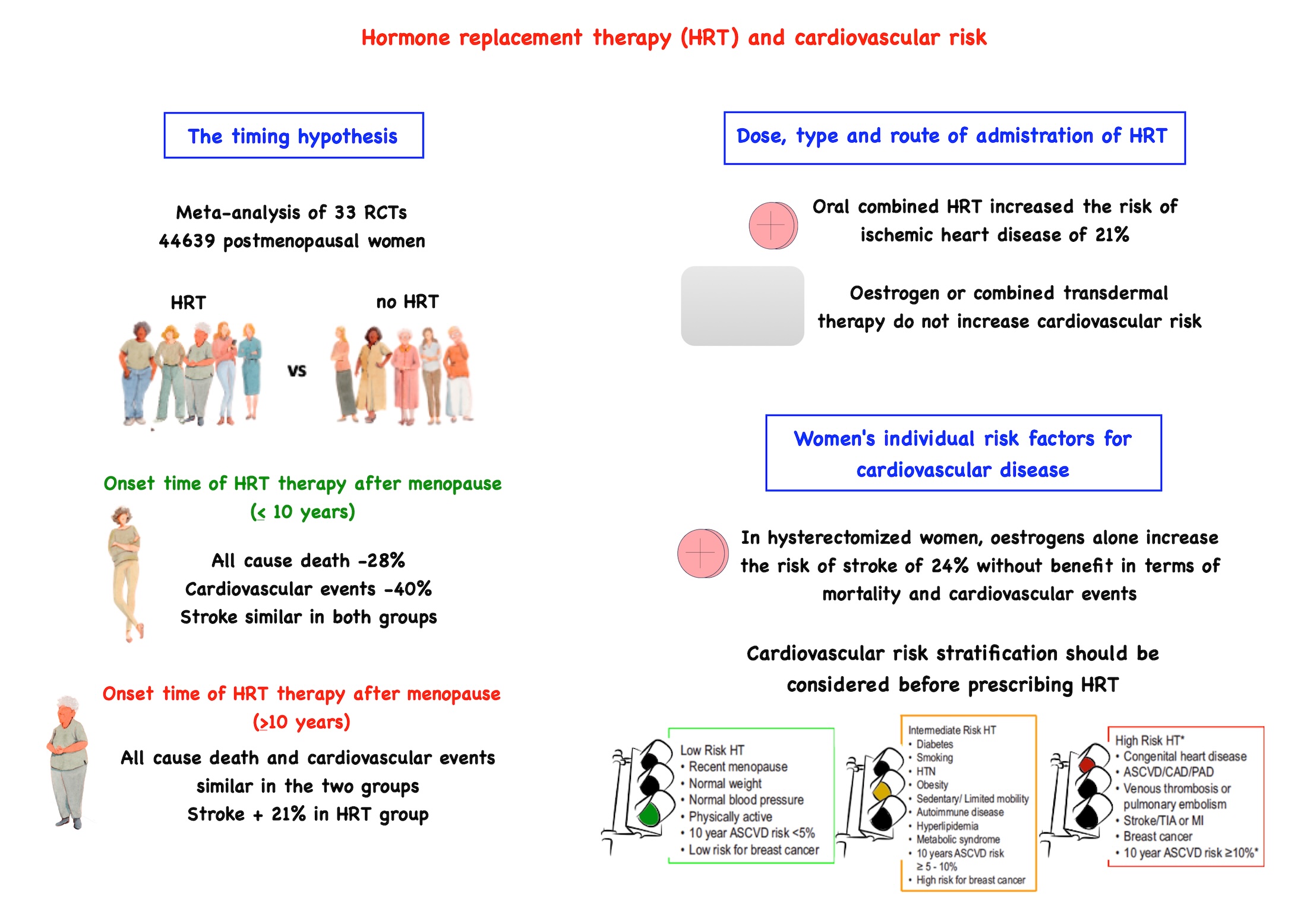
Hormone replacement therapy (HRT) effectively alleviates vasomotor symptoms related to menopause, but it can also raise the risk of cardiovascular disease. Several factors influence the likelihood of developing coronary artery disease or ischemic stroke, including a woman's age, the time since menopause, the type, dose, and route of hormone therapy administration, as well as woman’s personal risk factors and existing or past health conditions. Starting HRT at an older age or more than 10 years after menopause increases the risk of ischemic stroke by 21% (RR=1.21, 95% CI 1.07-1.38), without any benefit in reducing mortality (RR=1.06, 95% CI 0.95-1.18) or cardiovascular events (RR=1.03, 95% CI 0.92-1.15). In contrast, beginning HRT at a younger age and within 10 years of menopause lowers all-cause mortality by 28% (RR=0.72, 95% CI 0.54-0.97), reduces cardiovascular events by 40% (RR=0.60, 95% CI 0.41-0.86), and does not significantly increase the risk of ischemic stroke (RR=1.37, 95% CI 0.91-2.05). Oral estrogen-progestin combinations are linked to a higher risk of ischemic heart disease (HR=1.21, 95% CI 1.00-1.46), and this effect depends on the dose. Therefore, it is advised to use the lowest effective estrogen dose. Progesterone, dydrogesterone, and levonorgestrel should be selected because they do not elevate cardiovascular risk. Transdermal estrogens or estrogen-progestins do not increase the risk of cardiovascular events and are recommended for women at moderate to high risk of stroke and coronary heart disease. A multidisciplinary approach may be beneficial for the safe and effective management of both menopausal symptoms and related conditions.

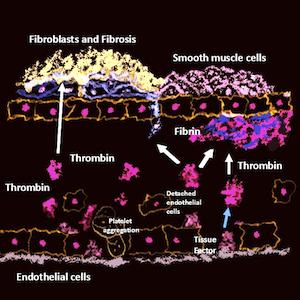
Graphical Abstract
Downloads

Download data is not yet available.

Citations

1. Minkin MJ. Menopause: hormones, lifestyle, and optimizing aging. Obstet Gynecol Clin N Am 2019; 46: 501-14. DOI: https://doi.org/10.1016/j.ogc.2019.04.008
2. El Khoudary SR, Greendale G, Crawford SL, et al. The menopause transition and women's health at midlife: a progress report from the Study of Women's Health Across the Nation (SWAN). Menopause 2019; 26: 1213-27. DOI: https://doi.org/10.1097/GME.0000000000001424
3. Shampo MA, Kyle RA, Steensma DP. Adolf Butenandt - Nobel Prize for Chemistry. Mayo Clin Proc 2012;87:e27. DOI: https://doi.org/10.1016/j.mayocp.2011.12.019
4. Cho L, Kaunitz AM, Faubion SS, et al. Rethinking menopausal hormone therapy: for whom, what, when, and how long? Circulation 2023;147:597-610. DOI: https://doi.org/10.1161/CIRCULATIONAHA.122.061559
5. Wilson R. Feminine Forever. New York, M. Evans & Co.; 1966.
6. Ziel HK, Finkle WD. Increased risk of endometrial carcinoma among users of conjugated estrogens. New Engl J Med 1975; 293:1167-70. DOI: https://doi.org/10.1056/NEJM197512042932303
7. Stampfer MJ, Graham AC, Willet WC, et al. Postmenopausal estrogen therapy and cardiovascular disease. N Engl J Med 1991;325:756-62. DOI: https://doi.org/10.1056/NEJM199109123251102
8. Hulley S, Grady D, Bush T, et al. Randomized trial of estrogen plus progestin for secondary prevention of coronary heart disease in postmenopausal woman. JAMA 1998;280:605-13. DOI: https://doi.org/10.1001/jama.280.7.605
9. Grady D, Herrington D, Bittner V, et al. Cardiovascular disease outcomes during 6.8 years of hormone therapy. Heart and estrogen/progestin replacement study follow-up (HERS II). JAMA 2002;288:49-57. DOI: https://doi.org/10.1001/jama.288.1.49
10. Rossouw JE, Anderson GL, Prentice RL, et al. Risk and benefit of estrogen plus progestin in healthy postmenopausal women. Principal results from the Women’s Health Initiative randomized controlled trial. JAMA 2002;288:321-33. DOI: https://doi.org/10.1001/jama.288.3.321
11. Manson JE, Chlebowski RT, Stefanick ML, et al. The Women’s Health Initiative Hormone Therapy Trials: update and overview of health outcomes during the intervention and post-stopping phases. JAMA 2013;310:1353-68. DOI: https://doi.org/10.1001/jama.2013.278040
12. Hodis HN, Mack WJ, Henderson VW, et al. Vascular effects of early versus late postmenopausal treatment with estradiol. N Engl J Med 2016;374:1221-31. DOI: https://doi.org/10.1056/NEJMoa1505241
13. Gu Y, Han F, Xue M, et al. The benefits and risks of menopause hormone therapy for the cardiovascular system in postmenopausal women: a systematic review and meta‑analysis. BMC Womens Health 2024;24:60. DOI: https://doi.org/10.1186/s12905-023-02788-0
14. Chen Z, Yuhanna IS, Galcheva-Gargova ZI, et al. Estrogen receptor alpha mediates the nongenomic activation of endothelial nitric oxide synthase by estrogen. J Clin Invest 1999;103:401-6. DOI: https://doi.org/10.1172/JCI5347
15. Krasinski K, Spyridopoulos I, Asahara T, et al. Estradiol accelerates functional endothelial recovery after arterial injury. Circulation 1997;95:1768-72. DOI: https://doi.org/10.1161/01.CIR.95.7.1768
16. No authors listed. Effects of estrogen or estrogen/progestin regimens on heart disease risk factors in postmenopausal women: the Postmenopausal Estrogen/Progestin Interventions (PEPI) Trial. The Writing Group for the PEPI Trial. JAMA 1995;273:199-208. DOI: https://doi.org/10.1001/jama.1995.03520270033028
17. Mendelsohn ME, Karas RH. Molecular and cellular basis of cardiovascular gender differences. Science 2005;48:1583-87. DOI: https://doi.org/10.1126/science.1112062
18. Canonico M, Carcaillon L, Plu-Bureau G, et al. Postmenopausal hormone therapy and risk of stroke impact of the route of estrogen administration and type of progestogen. Stroke 2016;47:1734-41. DOI: https://doi.org/10.1161/STROKEAHA.116.013052
19. Johansson T, Karlsson T, Bliuc D, et al. Contemporary menopausal hormone therapy and risk of cardiovascular disease: Swedish nationwide register based emulated target trial. BMJ 2024;387:e078784. DOI: https://doi.org/10.1136/bmj-2023-078784
20. Stuenkel CA, Davis SR, Gompel A, et al. Treatment of symptoms of the menopause: an Endocrine Society clinical practice guideline. J Clin Endocrinol Metab 2015;100:3975-4011. DOI: https://doi.org/10.1210/jc.2015-2236
21. Kernan CBWN, Sharrief AZ, Chaturvedi S, et al. 2024 Guideline for the Primary Prevention of Stroke: A Guideline From the American Heart Association/American Stroke Association. Stroke 2024;55:e344-e424. DOI: https://doi.org/10.1161/STR.0000000000000482
22. Santen RJ. Use of cardiovascular age for assessing risks and benefits of menopausal hormone therapy. Menopause 2017;24:589-95. DOI: https://doi.org/10.1097/GME.0000000000000847
23. Wild RA, Hovey KM, Andrews C et al. Cardiovascular Disease (CVD) risk scores, age or years since menopause to predict cardiovascular disease in the women’s health initiative. Menopause 2021;28:610-18. DOI: https://doi.org/10.1097/GME.0000000000001753
24. D’Agostino RB, Vasan RS, Pencina MJ, et al. General cardiovascular risk profile for use in primary care: the Framingham Heart Study. Circulation 2008;117:743-53. DOI: https://doi.org/10.1161/CIRCULATIONAHA.107.699579
25. Stone NJ, Robinson JG, Lichtenstein AH, et al. 2013 ACC/AHA guideline on the treatment of blood cholesterol to reduce atherosclerotic cardiovascular risk in adults: a report of the American College of Cardiology/American Heart Association Task Force on Practice Guidelines. J Am Coll Cardiol 2014;63:2889-934. DOI: https://doi.org/10.1016/j.jacc.2013.11.002

How to Cite


1.
Barcellona D. Cardiovascular risk in hormone replacement therapy. Bleeding Thromb Vasc Biol [Internet]. 2026 Feb. 9 [cited 2026 Apr. 30];5(1). Available from: https://www.btvb.org/btvb/article/view/411

Most read articles by the same author(s)