
PO10 | RISK OF VENOUS THROMBOEMBOLISM IN CANCER PATIENTS WITH CENTRAL VENOUS CATHETERS: RESULTS FROM THE VIENNA CAT-BLED STUDY
B. Sunder-Plassmann 1, N, Vladic1, C. Englisch1, F. Moik1|3, V. Sunder-Plassmann2, A. Berghoff2, M. Preusser2, I. Pabinger1, C. Ay1 | 1Division of Hematology and Haemostaseology, Department of Medicine I, Medical University of Vienna; Vienna, Austria; 2Division of Oncology, Department of Medicine I, Medical University of Vienna; Vienna, Austria; 3Division of Oncology, Department of Internal Medicine, Medical University of Graz; Graz, Austria

All claims expressed in this article are solely those of the authors and do not necessarily represent those of their affiliated organizations, or those of the publisher, the editors and the reviewers. Any product that may be evaluated in this article or claim that may be made by its manufacturer is not guaranteed or endorsed by the publisher.
Authors
Background. Venous thromboembolism (VTE) is a common complication in patients with cancer. Central venous catheters (CVCs) are frequently required for the application of systemic anti-cancer treatments. Although CVCs are known risk factors for VTE, researchers have limited prospective data on the risk of VTE—and especially catheter-related thrombosis (CRT)—in patients with cancer.
Aim. We aimed to assess the incidence rate of all VTE events and CRTs in patients with cancer receiving contemporary anti-cancer treatment during catheter dwell time.
Methods. This analysis was conducted within the framework of the Vienna Cancer, Thrombosis, and Bleeding (CAT-BLED) Study. Patients with newly diagnosed or recurrent cancer who initiated systemic anti-cancer treatment between May 2019 and December 2022 and had a CVC in place at inclusion or inserted during follow-up were included, while patients who were receiving anticoagulation already at inclusion were excluded. CVCs were classified as Port-a-Cath (PAC), Peripherally-Inserted-Central-Catheter (PICC), or non-tunnelled CVC. Patients were screened for VTEs prospectively during catheter dwell time. VTEs were defined as deep vein thrombosis (DVT), pulmonary embolism (PE), concomitant DVT and PE, splanchnic vein thrombosis (SVT), or CRT. All VTEs were adjudicated by an independent adjudication committee. Incidence rates per 1,000 catheter-days were calculated.
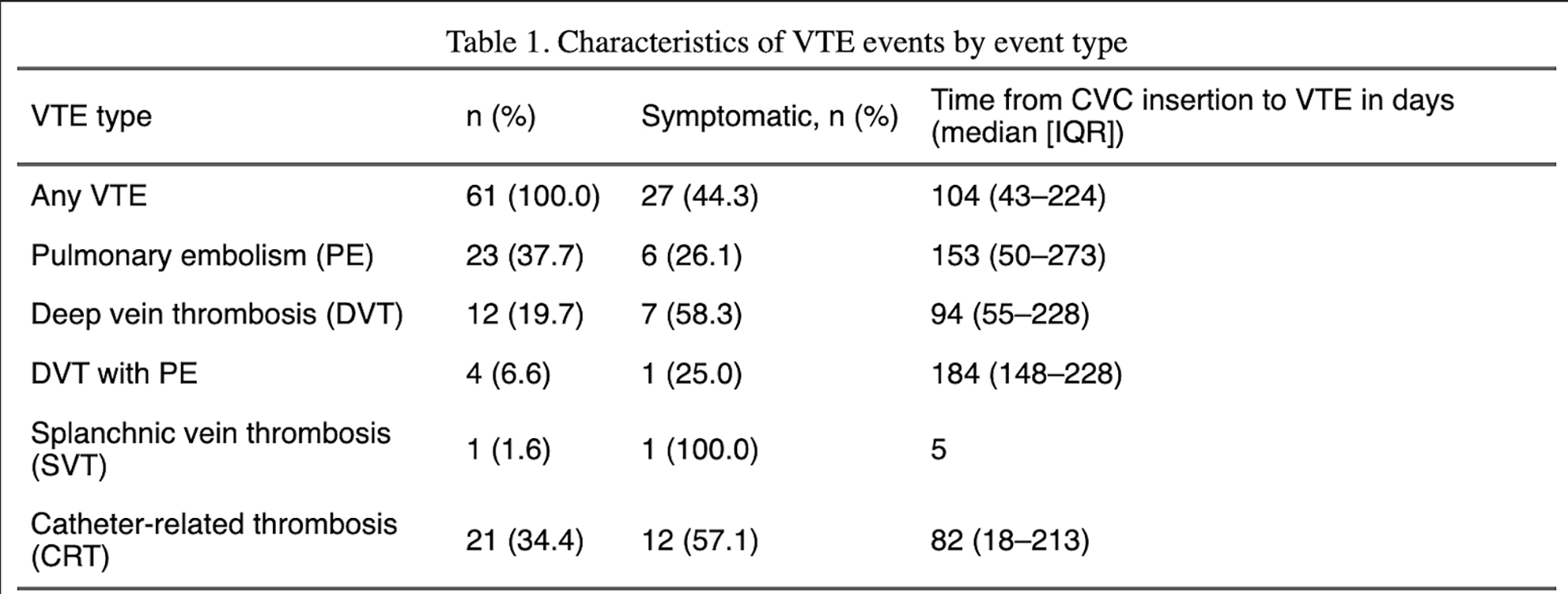
Results. This analysis included a total of 358 patients (52.5% female), with a median age of 60 years (interquartile range [IQR]: 52-67). At the time of inclusion, 248 (70.5%) patients had metastatic disease. Over a median follow-up of 13.7 months (IQR: 8.2-25.4), a total of 404 CVCs were implanted among the study cohort. Most patients received a single CVC (n=325), followed by two (n=27) and three or more (n=6). CVCs were most commonly PACs (82.2%), followed by PICCs (17.3%) and non-tunnelled CVCs (0.5%). Median catheter dwell time was 250 days (IQR: 78-582) with a total of 61 confirmed VTEs (details on VTE characteristics are in Table 1). The incidence rates per 1,000 catheter-days were 0.41 for any VTE and 0.26 for CRT alone. No CRT was recorded with a PICC in place. CRTs were observed in both patients with non-tunnelled CVCs.
Conclusions. VTE occurred at clinically relevant rates during CVC dwell time, with CRT accounting for a substantial proportion. Device-specific differences warrant further investigations. 
Downloads
Citations




How to Cite

This work is licensed under a Creative Commons Attribution-NonCommercial 4.0 International License.