
The von Willebrand factor-ADAMTS-13 axis: a two-faced Janus in bleeding and thrombosis
All claims expressed in this article are solely those of the authors and do not necessarily represent those of their affiliated organizations, or those of the publisher, the editors and the reviewers. Any product that may be evaluated in this article or claim that may be made by its manufacturer is not guaranteed or endorsed by the publisher.
Accepted: 1 April 2022
Authors
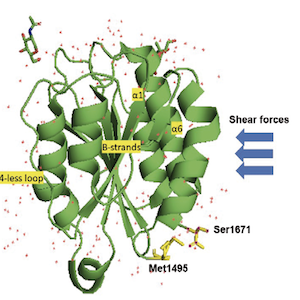
von Willebrand factor (VWF), a blood multimeric protein with a very high molecular weight, plays a crucial role in the primary hemostasis, the physiological process characterized by the adhesion of blood platelets to the injured vessel wall. Hydrodynamic forces are responsible for the VWF multimers conformational transitions from a globular to a stretched linear conformation. These characteristics render this protein a valuable object to be investigated by mechanochemistry, the biophysical chemistry branch that studies the effects of shear forces on protein conformation. This review will focus on the structural elements of the VWF molecule involved in the biochemical response to shear forces. The stretched VWF conformation favors the interaction with the platelet GpIb and at the same time with ADAMTS-13, the zinc-protease that cleaves VWF in the A2 domain, limiting its prothrombotic capacity. It is important to consider the level or the function of VWF or ADAMTS-13 always in relation each other, keeping in mind that in many thrombotic forms of microangiopathies the reduction of the ratio between the ADAMTS-13 activity and the VWF level (lower than 0.5) can be a valuable parameter to predict a real thrombotic risk. Hence, a significant increase in VWF level alone, even without any reduction of ADAMTS-13 concentration, would still be responsible for a significant reduction of the ADAMTS-13/VWF ratio, which ultimately could reflect or predict a prothrombotic risk. Future studies will have to validate the concept whether ADAMTS-13/VWF ratio could a valuable and reliable biomarker to predict or confirm the presence of thrombotic risk in several morbid conditions.
Downloads
Citations




How to Cite

This work is licensed under a Creative Commons Attribution-NonCommercial 4.0 International License.