
PO55 | HISTORY OF CANCER IN PATIENTS WITH SEVERE HEREDITARY THROMBOPHILIA VERSUS NO THROMBOPHILIA: A SINGLE-CENTER COHORT OF PATIENTS WITH VENOUS THROMBOSIS
A. Napolitano, E. Campello, C. Simion, G. Furlan, S. Gavasso, C. Bulato, C. Samà, S. Toffanin, B. Serena, L. Spiezia, P. Simioni | Internal Medicine 1 and Thrombotic and Hemorrhagic Diseases Unit, Department of Medicine, University of Padova, Italy

All claims expressed in this article are solely those of the authors and do not necessarily represent those of their affiliated organizations, or those of the publisher, the editors and the reviewers. Any product that may be evaluated in this article or claim that may be made by its manufacturer is not guaranteed or endorsed by the publisher.
Authors
Introduction. Hypercoagulability is a hallmark of cancer and may contribute to tumor progression. Severe hereditary thrombophilia represents a lifelong prothrombotic condition, but its association with cancer remains unclear.
Aim. The aim is to compare the prevalence of cancer in patients with severe hereditary thrombophilia versus patients without thrombophilia.
Methods. We conducted a single-center observational study including consecutive patients with venous thrombosis. Patients were classified as having severe hereditary thrombophilia or no thrombophilia based on standardized testing. The primary outcome was a history of cancer (ever having cancer), defined as any solid or hematological malignancy diagnosed at any time. Age at thrombosis was used as the age at study inclusion. Cancer prevalence was compared using Poisson regression models with a log link and robust standard errors to estimate prevalence ratios (PR), adjusted for age and sex.
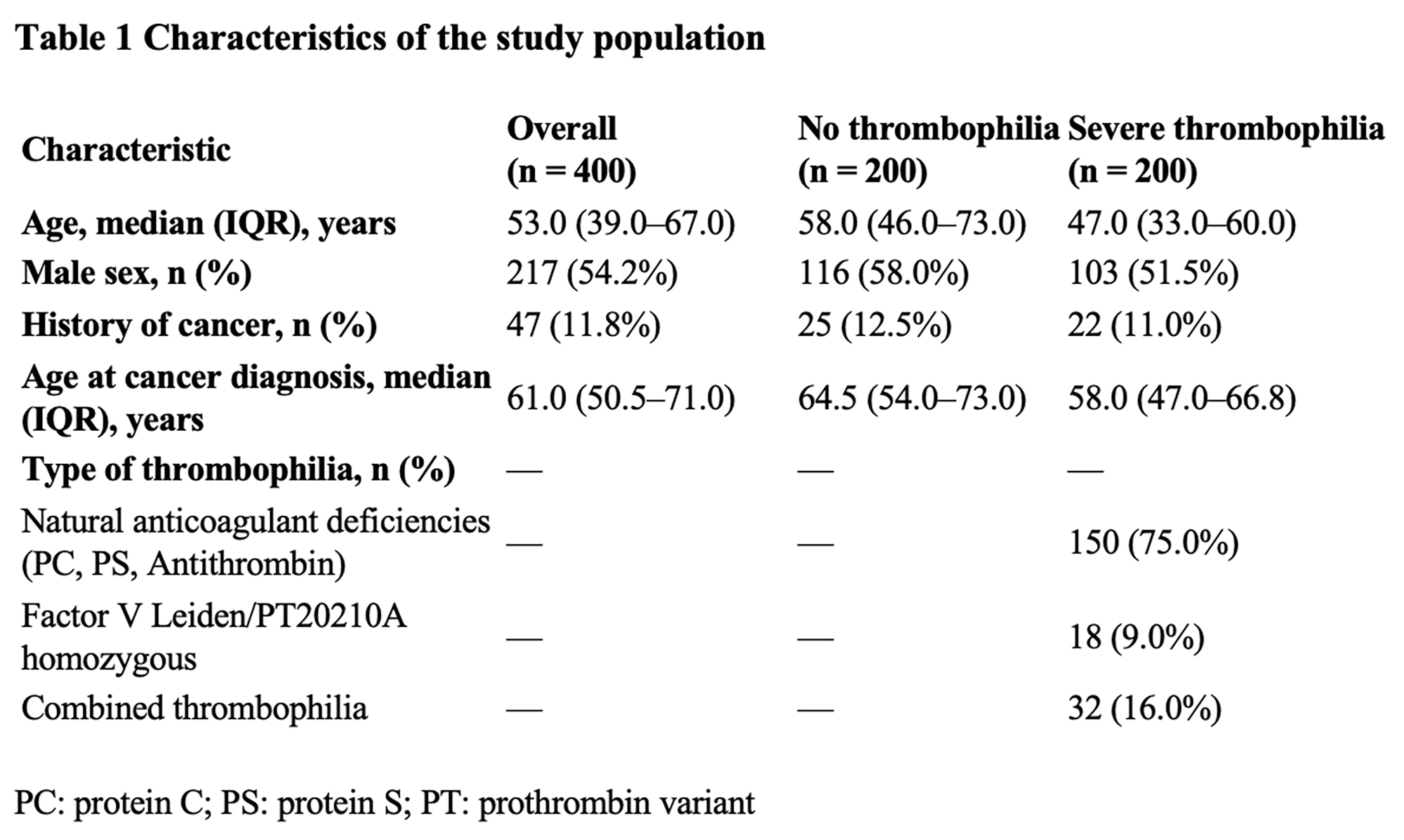
Results. A total of 400 patients were included (200 with severe hereditary thrombophilia and 200 without) (Table 1). Cancer prevalence was similar between groups (11.0% vs 12.5%). In multivariable regression adjusted for age and sex, severe hereditary thrombophilia was not associated with a higher prevalence of cancer (PR 1.33, 95% CI 0.67–2.58, p=0.403). Increasing age was independently associated with cancer prevalence (PR per year 1.05, CI 1.03–1.07, p<0.001), while male sex was associated with a lower prevalence of cancer (PR 0.51, 95% CI 0.26–0.94, p = 0.039). Thrombophilia-by-sex interaction was not significant (p=0.712). Among patients with cancer, those with severe thrombophilia were diagnosed at a younger age (58 [IQR 46–67] y) vs. patients without (64.5 [IQR 54–73] y) in univariable analysis. However, in exploratory multivariable linear regression adjusting for sex and age at thrombosis, severe thrombophilia was not independently associated with age at cancer diagnosis (β −3.9 years, p=0.31). In sensitivity analyses, thrombophilia subtypes were grouped into defects of natural anticoagulants and other thrombophilias. No independent association with cancer prevalence was observed.
Conclusions. Severe hereditary thrombophilia was not associated with an increased prevalence of cancer. Age was the main determinant of cancer burden, and the apparent younger age at cancer diagnosis among thrombophilic patients was largely explained by baseline age differences. These findings do not support intensified cancer screening that relies solely on thrombophilia status.

Downloads
Citations




How to Cite

This work is licensed under a Creative Commons Attribution-NonCommercial 4.0 International License.
Most read articles by the same author(s)
- ICTHIC 2026, PO60 | VEXAS SYNDROME AS A NEW SEVERE THROMBOPHILIC CLONAL CONDITION: A SINGLE CENTRE EXPERIENCE , Bleeding, Thrombosis and Vascular Biology: Vol. 5 No. s1 (2026)
- ICTHIC 2026, OC02 | INCIDENCE AND PREDICTORS OF ARTERIAL THROMBOSIS IN CANCER PATIENTS: RESULTS FROM THE PROSPECTIVE COMPASS-ARTERIAL CANCER ASSOCIATED THROMBOSIS (COMPASS-ARTECAT) STUDY , Bleeding, Thrombosis and Vascular Biology: Vol. 5 No. s1 (2026)
- ICTHIC 2026, PO05 | DESIGN, SYNTHESIS, AND BIOLOGICAL EVALUATION OF NOVEL IMATINIB AND NILOTINIB ANALOGUES EXPRESSING ENHANCED ANTIPLATELET AND ANTICANCER ACTIVITIES , Bleeding, Thrombosis and Vascular Biology: Vol. 5 No. s1 (2026)
- ICTHIC 2026, PO58 | TACKLING THE AWARENESS GAP IN CANCER-ASSOCIATED THROMBOSIS: IMPACT OF A BRIEF EDUCATIONAL INTERVENTION IN PATIENTS WITH GYNECOLOGICAL CANCERS , Bleeding, Thrombosis and Vascular Biology: Vol. 5 No. s1 (2026)
- ICTHIC 2026, PO57 | A NOVEL RISK ASSESSMENT MODEL FOR CANCER DETECTION WITHIN ONE YEAR AFTER INCIDENT VENOUS THROMBOEMBOLISM , Bleeding, Thrombosis and Vascular Biology: Vol. 5 No. s1 (2026)
- ICTHIC 2026, PO18 | THE THROMBO-INFLAMMATION AXIS AS PREDICTOR OF TOXICITY IN PATIENTS TREATED WITH CAR-T CELLS , Bleeding, Thrombosis and Vascular Biology: Vol. 5 No. s1 (2026)
- ICTHIC 2026, PO32 | ANTICOAGULANT THROMBOPROPHYLAXIS IN AGGRESSIVE LYMPHOMAS PATIENTS: PREDICTIVE THROMBOTIC RISK SCORES AND RISK FACTORS , Bleeding, Thrombosis and Vascular Biology: Vol. 5 No. s1 (2026)
- ICTHIC 2026, PO26 | OUTCOMES OF DIRECT ORAL ANTICOAGULANTS IN UNUSUAL-SITE THROMBOSIS: IMPACT OF ACTIVE CANCER , Bleeding, Thrombosis and Vascular Biology: Vol. 5 No. s1 (2026)
- ICTHIC 2026, PO41 | VENOUS THROMBOEMBOLISM IN PERIPHERAL BLOOD STEM CELL COLLECTION. A SINGLE CENTER EXPERIENCE , Bleeding, Thrombosis and Vascular Biology: Vol. 5 No. s1 (2026)
- ICTHIC 2026, PO51 | MECHANISTIC POPULATION PHARMACOKINETIC/PHARMACODYNAMIC MODELING OF FACTOR XI-TARGETING MONOCLONAL ANTIBODIES SUPPORTS DURABLE ANTICOAGULANT COVERAGE AND TRANSLATIONAL DOSE AND REGIMEN SELECTION , Bleeding, Thrombosis and Vascular Biology: Vol. 5 No. s1 (2026)