
PO51 | MECHANISTIC POPULATION PHARMACOKINETIC/PHARMACODYNAMIC MODELING OF FACTOR XI-TARGETING MONOCLONAL ANTIBODIES SUPPORTS DURABLE ANTICOAGULANT COVERAGE AND TRANSLATIONAL DOSE AND REGIMEN SELECTION
O. Milberg1, H. Abdallah1, R.K. Lokken2, R. Dingman1, K.A. Meagher1, M.E. Burczynski1, E. Marin1, A.P. Kithcart1, D. E. Gutstein1 | 1Regeneron Pharmaceuticals, Inc., Tarrytown, NY, USA; 2Allucent, Cary, NC, USA

All claims expressed in this article are solely those of the authors and do not necessarily represent those of their affiliated organizations, or those of the publisher, the editors and the reviewers. Any product that may be evaluated in this article or claim that may be made by its manufacturer is not guaranteed or endorsed by the publisher.
Authors
Introduction. Factor XI (FXI) inhibition is a promising anticoagulant strategy with potential for reduced bleeding risk versus standard of care therapies. With small-molecule and antibody (Ab)-based approaches such as abelacimab in clinical development, it is important to understand how pharmacokinetic/pharmacodynamic (PK/PD) properties and dose and regimen selection influence FXI inhibition durability.
Aim. To develop a PK/PD framework for FXI inhibition by REGN7508CAT and REGN9933A2 Abs in healthy volunteers (HVs), quantify sources of interindividual variability, and support translational dose and regimen selection.
Materials and Methods. Data from first-in-human HV studies (6:2 active:placebo) of REGN7508CAT (NCT05603195) and REGN9933A2 (NCT05102136) subcutaneous or intravenous (IV) administrations were integrated using target-mediated drug disposition (TMDD) models in MonolixSuite 2024R1. Models described total and functional drug concentrations, total FXI concentrations, and activated partial thromboplastin time (aPTT) prolongation. Allometric bodyweight scaling was applied to PK. Covariate effects were screened using the Conditional Sampling used for the Stepwise Approach based on Correlation tests (COSSAC). Simulations and visualization were performed in Simulx and R 4.2.2.
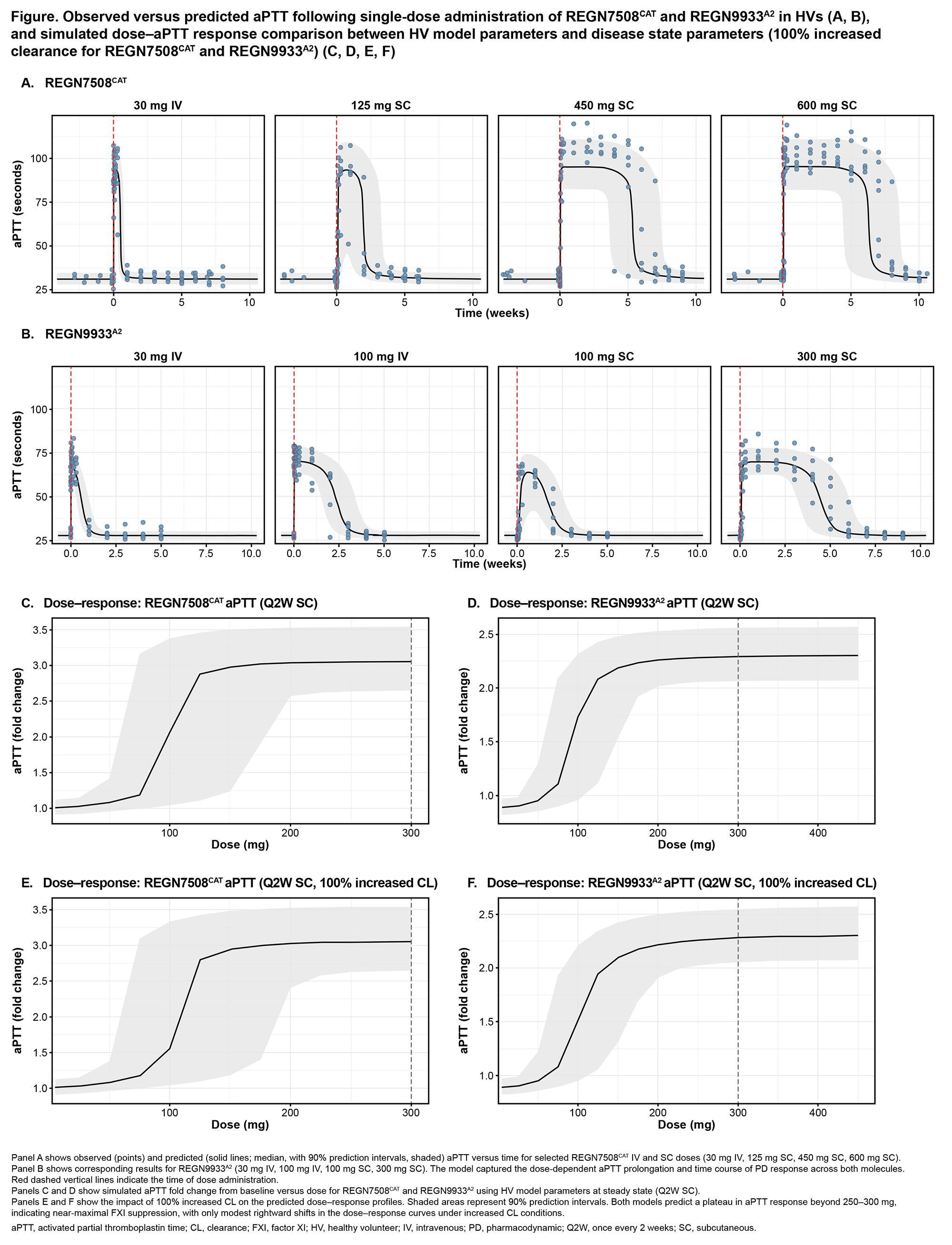
Results. The TMDD models captured nonlinear PK/PD effects following REGN7508CAT and REGN9933A2 administration. Dose-dependent aPTT prolongation with sustained PD plateaus was consistent with target saturation and epitope binding. Compared with small-molecule FXI inhibition reported in the literature, Ab-based FXI inhibition demonstrated longer PD coverage, rapid IV onset, and reduced sensitivity to peak-trough fluctuations. Under two-fold clearance stress, simulated Q2W dosing maintained continuous FXI suppression and aPTT response over the full dosing interval in >95% of HVs. In contrast, previously reported HV data for Q4W FXI Ab regimens suggest incomplete maintenance of FXI suppression over the full dosing interval.
Conclusions. Mechanistic TMDD modeling demonstrates that Ab-based FXI inhibition provides durable, robust anticoagulant coverage relative to small-molecule approaches. Within the Ab class, dose and regimen selection are critical for maintaining continuous PD coverage. Q2W regimens for REGN7508CAT and REGN9933A2 maintained full dosing-interval FXI suppression under clearance stress, supporting translational dose and regimen selection across physiological conditions.

Downloads
Citations




How to Cite

This work is licensed under a Creative Commons Attribution-NonCommercial 4.0 International License.
Most read articles by the same author(s)
- ICTHIC 2026, PO13 | OUTPATIENT TREATMENT OF VENOUS THROMBOEMBOLISM AND SUBSEQUENT RISK OF CANCER , Bleeding, Thrombosis and Vascular Biology: Vol. 5 No. s1 (2026)
- ICTHIC 2026, PO17 | PREDICTIVE VALUE OF INFLAMMATORY AND ENDOTHELIAL BIOMARKERS FOR CANCER RISK IN HEALTHY INDIVIDUALS: EVIDENCE FROM THE HYPERCAN STUDY , Bleeding, Thrombosis and Vascular Biology: Vol. 5 No. s1 (2026)
- ICTHIC 2026, PO27 | URINE QUALITATIVE ASSESSMENT OF DIRECT ORAL ANTICOAGULANTS IN ROUTINE CLINICAL PRACTICE , Bleeding, Thrombosis and Vascular Biology: Vol. 5 No. s1 (2026)
- ICTHIC 2026, PO23 | IMMUNE THROMBOTIC THROMBOCYTOPENIC PURPURA RELATED TO DELAYED IMMUNE CHECKPOINT INHIBITORS TOXICITY: A CASE REPORT , Bleeding, Thrombosis and Vascular Biology: Vol. 5 No. s1 (2026)