
PO50 | SUB-ANALYSIS OF INTERIM RESULTS FROM A PHASE 2 STUDY INVESTIGATING REGN9933A2 AND REGN7508CAT FOR THE PREVENTION OF CONTACT-MEDIATED VENOUS THROMBOEMBOLISM IN PATIENTS WITH ACTIVE CANCER UNDERGOING PERIPHERALLY INSERTED CENTRAL CATHETER PLACEMENT (ROXI-CATH)
J. Zwicker1,2, A.P. Kithcart3, J. Kaplan3, Y-C. Cheng3, J.G. Raya3, J. Xiao3, S. Li3, K. Musgrave4, D.E. Gutstein3, G. Piazza5 | 1Memorial Sloan Kettering Cancer Center, New York, NY, USA; 2Weill Cornell Medical Center, New York, NY, USA; 3Regeneron Pharmaceuticals, Inc. , Tarrytown, NY, USA; 4Newcastle upon Tyne Hospitals NHS Foundation Trust, Newcastle upon Tyne, UK; 5Brigham and Women’s Hospital, Boston, MA, USA

All claims expressed in this article are solely those of the authors and do not necessarily represent those of their affiliated organizations, or those of the publisher, the editors and the reviewers. Any product that may be evaluated in this article or claim that may be made by its manufacturer is not guaranteed or endorsed by the publisher.
Authors
Introduction. Thrombosis is a common complication of PICC placement. Available anticoagulants can increase bleeding risk and are rarely used for thromboprophylaxis in patients (pts) with PICC lines. Factor XI (FXI) inhibition may reduce thrombosis risk after PICC placement without increased bleeding risk in pts with cancer at enhanced risk of clotting and bleeding. REGN9933A2 and REGN7508CAT are human monoclonal antibodies binding the A2 and catalytic FXI domains, respectively. The Phase 2 ROXI-CATH study (NCT06299111) evaluated REGN9933A2 and REGN7508CAT for preventing contact-mediated VTE after PICC placement.
Aim. To assess the efficacy and safety of REGN9933A2 and REGN7508CAT in pts from ROXI-CATH with active cancer undergoing PICC placement.
Materials and Methods. In this ongoing double-blind study, pts ≥18 years undergoing PICC placement (in place for ≥14 days) were randomized 1:1:1 to receive intravenous REGN9933A2 (300 mg), REGN7508CAT 250 mg, or placebo ≤24 hours of PICC placement. Ultrasound of the upper extremity ipsilateral to the PICC was performed on Day 7 and Day 14 (±2 days) for thrombosis assessment. Co-primary endpoints were the incidence of confirmed VTE until Day 14 after PICC placement and the incidence and severity of treatment-emergent adverse events (TEAEs). A sub-analysis at ~50% enrollment of patients with active cancer is presented.
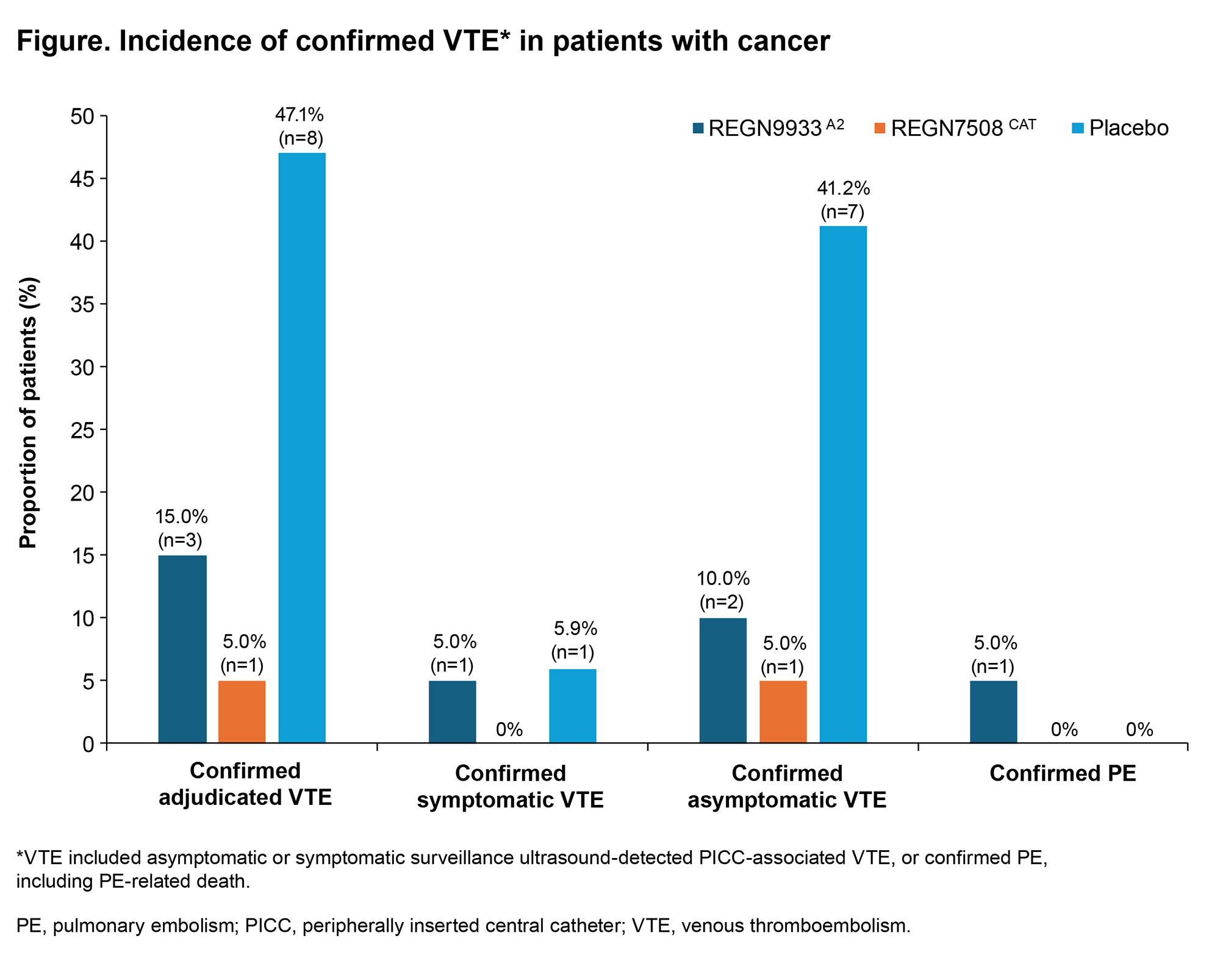
Results. As of July 30, 2025, 58 pts with active cancer were enrolled and treated (REGN9933A2, n=20; REGN7508CAT, n=20; placebo, n=18). In the efficacy analysis set (n=57), VTE occurred in 3 (15.0%) pts receiving REGN9933A2, 1 (5.0%) receiving REGN7508CAT, and 8 (47.1%) receiving placebo (Figure). Odds ratios for VTE for REGN9933A2 and REGN7508CAT vs placebo were 0.29 (90% CI 0.06–0.73) and 0.13 (90% CI 0.02–0.36), respectively. No major bleeding occurred (safety analysis set, n=58); clinically relevant non-major bleeding occurred in one pt receiving REGN9933A2 and one receiving placebo. Treatment-related TEAEs occurred in one pt receiving REGN9933A2 (anemia and epistaxis) and one receiving REGN7508CAT (overdose); none occurred in the placebo group.
Conclusions. FXI inhibition may be effective for preventing contact-mediated VTE in pts with active cancer, with lower VTE rates in those receiving REGN9933A2 or REGN7508CAT than in placebo. FXI inhibition represents a novel potential anticoagulant approach to preventing PICC-associated thrombosis in pts with cancer without substantially increasing the bleeding risk.
Downloads
Citations




How to Cite

This work is licensed under a Creative Commons Attribution-NonCommercial 4.0 International License.