
PO32 | ANTICOAGULANT THROMBOPROPHYLAXIS IN AGGRESSIVE LYMPHOMAS PATIENTS: PREDICTIVE THROMBOTIC RISK SCORES AND RISK FACTORS
L. Gurgoglione1, G. Gini1, S. Rupoli1, A. Poloni1|2 | 1Hematology, AOU delle Marche, Ancona; 2Università Politecnica delle Marche, Ancona, Italy

All claims expressed in this article are solely those of the authors and do not necessarily represent those of their affiliated organizations, or those of the publisher, the editors and the reviewers. Any product that may be evaluated in this article or claim that may be made by its manufacturer is not guaranteed or endorsed by the publisher.
Authors
Introduction. Lymphoma patients have a well-known increased risk of thrombosis, which can cause therapy delays and increase mortality. The use of thromboprophylaxis in this setting could improve such odds, but there are no international guidelines for anticoagulant prophylaxis. The different scores used in cancer patients are mostly not developed in this specific subset, and they’ve not been validated.
Aim. We conducted a retrospective monocentric study to evaluate the predictive value of the most used risk score (Khorana, Conko, and Throly) in this setting, while also evaluating single risk factors. We also evaluated the safety and effectiveness of anticoagulant thromboprophylaxis.
Materials and Methods. We collected the data of 302 patients with a histological diagnosis of aggressive lymphomas (both new and relapsed) between 2021 and 2024 at AOU delle Marche. Anticoagulant prophylaxis with LMWH was administered according to clinical judgment. We collected the clinical and laboratory findings, risk factors, survival data, and the incidence of bleeding and thrombotic events. The relative risks were calculated with a 95% confidence interval.
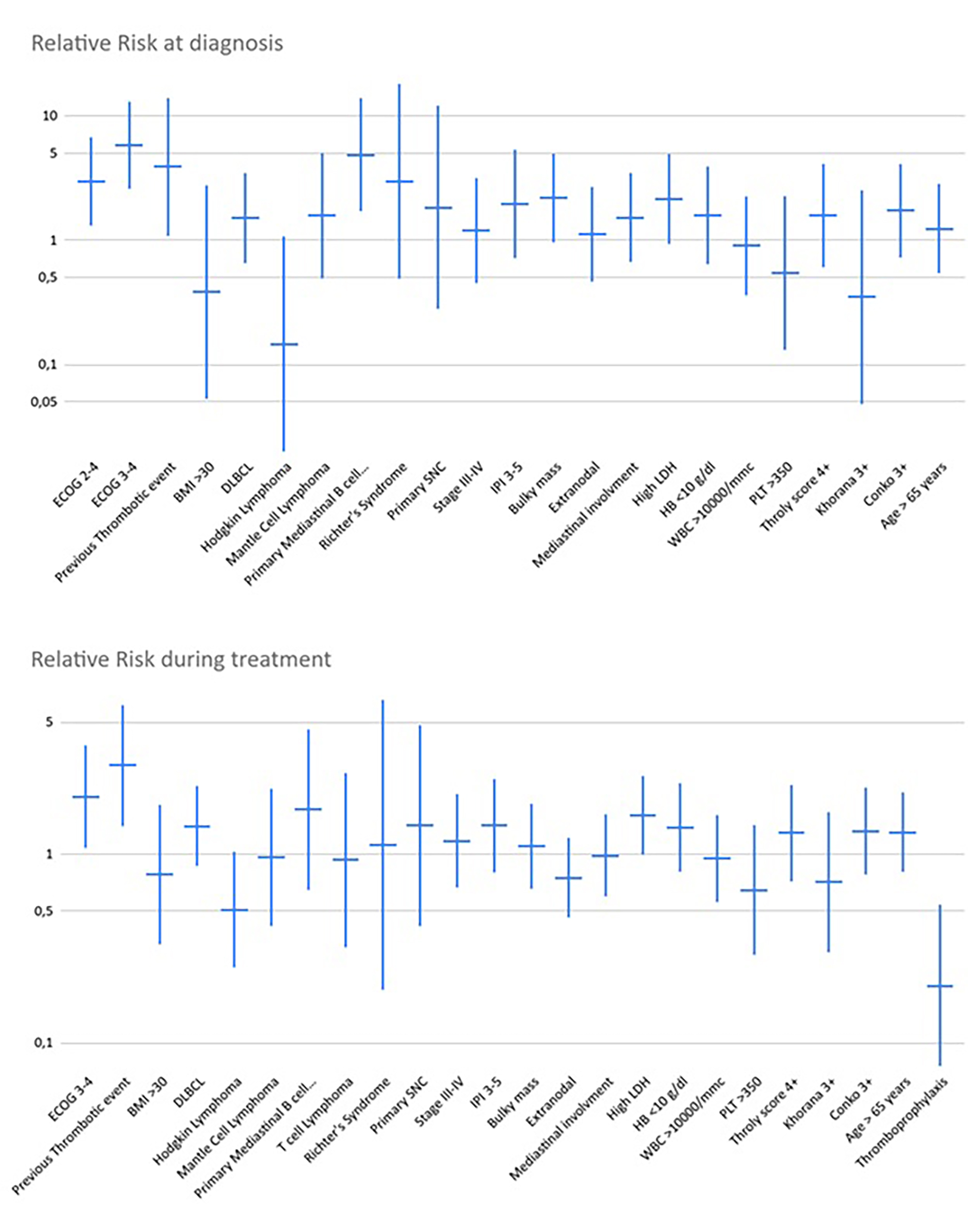
Results. 86 patients received anticoagulant prophylaxis and 24 patients were already in full anticoagulant therapy. 54 patients (17.88%) had a thromboembolic event, 6 during thromboprophylaxis. All were treated and none were fatal. No risk score was able to predict the thrombotic risk in a statistically significant way (Figure 1). Among all the analyzed items, only ECOG >2 (RR 5.79 CI 2.59-12.97) (RR 2.01, CI 1.08-3.76) and a previous thrombotic event (RR 3.87, CI 1.08-13.87) (RR 2.94, CI 1.40-6.14) showed increased risk of thrombosis both at diagnosis and during treatment. Primary Mediastinal B-cell Lymphoma (RR 4.87, CI 1.71-13.87) showed an increased risk of thrombosis at the time of diagnosis. Anticoagulant prophylaxis decreased the risk of thrombosis (RR 0.20, CI 0.08-0.54), without an increased risk of bleeding (RR 1.03, CI 0.90-3.20).
Conclusions. Anticoagulant prophylaxis showed efficacy in preventing thromboembolic events without increased bleeding risk. However, patient selection for prophylaxis is still an unmet clinical need since there is still no reliable score. All scores analyzed in this study performed poorly, but we identified some new items that could be used for further development. New clinical studies are required to find new risk factors and to develop better scores in this setting.

Downloads
Citations




How to Cite

This work is licensed under a Creative Commons Attribution-NonCommercial 4.0 International License.
Most read articles by the same author(s)
- ICTHIC 2026, OC12 | RISK OF VENOUS THROMBOEMBOLISM AFTER REMOVAL OF AN UPPER EXTREMITY CENTRAL CATHETER ASSOCIATED WITH A DEEP VEIN THROMBOSIS IN CANCER PATIENTS , Bleeding, Thrombosis and Vascular Biology: Vol. 5 No. s1 (2026)
- ICTHIC 2026, PO16 | EPIDEMIOLOGY, CLINICAL CHARACTERISTICS, AND OUTCOMES OF PROVOKED AND UNPROVOKED PULMONARY EMBOLISM IN A MULTICULTURAL ISRAELI POPULATION , Bleeding, Thrombosis and Vascular Biology: Vol. 5 No. s1 (2026)
- ICTHIC 2026, OC11 | COMPLEXITIES IN MANAGING ANTITHROMBOTIC THERAPY IN PATIENTS WITH CANCER APPROACHING END-OF-LIFE: A MIXED METHOD INTEGRATION USING JOINT DISPLAY ANALYSIS , Bleeding, Thrombosis and Vascular Biology: Vol. 5 No. s1 (2026)
- ICTHIC 2026, OC13 | VON WILLEBRAND FACTOR PREDICTS POOR OUTCOME IN PANCREATIC CANCER AND MEDIATES TUMOR-ENDOTHELIUM INTERACTIONS FACILITATING METASTASIS , Bleeding, Thrombosis and Vascular Biology: Vol. 5 No. s1 (2026)
- ICTHIC 2026, PO04 | FIBRIN CLOT SHIELDS PROMOTE CLONAL SELECTION IN CANCER CELLS: PROCOAGULANT ACTIVITY AND SURVIVAL OF CLOT-EMBEDDED CELLS. A NOVEL TUMOR MICROENVIRONMENT MODEL , Bleeding, Thrombosis and Vascular Biology: Vol. 5 No. s1 (2026)
- ICTHIC 2026, PO07 | PLATELET INHIBITION BY THE NOVEL NITRIC OXIDE-DONOR NITROSOOXYPROPANOL , Bleeding, Thrombosis and Vascular Biology: Vol. 5 No. s1 (2026)
- ICTHIC 2026, PO25 | EVOLUTION OF ANTICOAGULANT STRATEGIES AND CLINICAL OUTCOMES IN CANCER-ASSOCIATED THROMBOSIS: A LONGITUDINAL ANALYSIS OF THE START2 REGISTRY ONCO-VTE , Bleeding, Thrombosis and Vascular Biology: Vol. 5 No. s1 (2026)
- ICTHIC 2026, PO34 | INVESTIGATORS’ DECISIONS ON ANTICOAGULATION AFTER EXTENDED API-CAT TREATMENT FOR CANCER VENOUS THROMBOEMBOLISM , Bleeding, Thrombosis and Vascular Biology: Vol. 5 No. s1 (2026)
- ICTHIC 2026, PO13 | OUTPATIENT TREATMENT OF VENOUS THROMBOEMBOLISM AND SUBSEQUENT RISK OF CANCER , Bleeding, Thrombosis and Vascular Biology: Vol. 5 No. s1 (2026)
- ICTHIC 2026, PO22 | LONG-TERM ANTICOAGULANT THERAPY AND REDUCTION OF OVARIAN CANCER RECURRENCE: CLINICAL EVIDENCE OF A POTENTIAL ANTITUMOUR EFFECT , Bleeding, Thrombosis and Vascular Biology: Vol. 5 No. s1 (2026)