
OC05 | TIME TO START OF ANTICOAGULANT THERAPY AND SURVIVAL OUTCOMES IN CANCER PATIENTS WITH PULMONARY EMBOLISM
K. Bria, B. Gage, M. Bealsey, K. Sanfilippo | Washington University in St. Louis School of Medicine, St. Louis, MO, USA

All claims expressed in this article are solely those of the authors and do not necessarily represent those of their affiliated organizations, or those of the publisher, the editors and the reviewers. Any product that may be evaluated in this article or claim that may be made by its manufacturer is not guaranteed or endorsed by the publisher.
Authors
Introduction. Pulmonary embolism (PE) is a leading cause of death in cancer. Those with cancer-associated thrombosis have mortality rates 2–5x higher than other cancer patients. Prior data shows that therapeutic anticoagulant therapy (AT) within 24 hours of PE diagnosis can reduce mortality.
Aim. We aimed to evaluate 30-day PE-associated mortality and time to start AT in patients with and without active cancer.
Methods. We performed a retrospective cohort study of patients who presented to the emergency room at Barnes Jewish Hospital with symptoms of PE between 1/2021 and 12/2025. Only patients initiated on AT with unfractionated or low-molecular-weight heparin and diagnosed with intermediate- or high-risk PE were included. We identified patients who died within 30 days from a PE-related cause and compared mortality rates in those with and without active cancer. We also compared the time from patient presentation (triage vital signs) to PE diagnosis (on objectively confirmed imaging studies), from PE diagnosis to the start of AT, and from patient presentation to the start of AT.
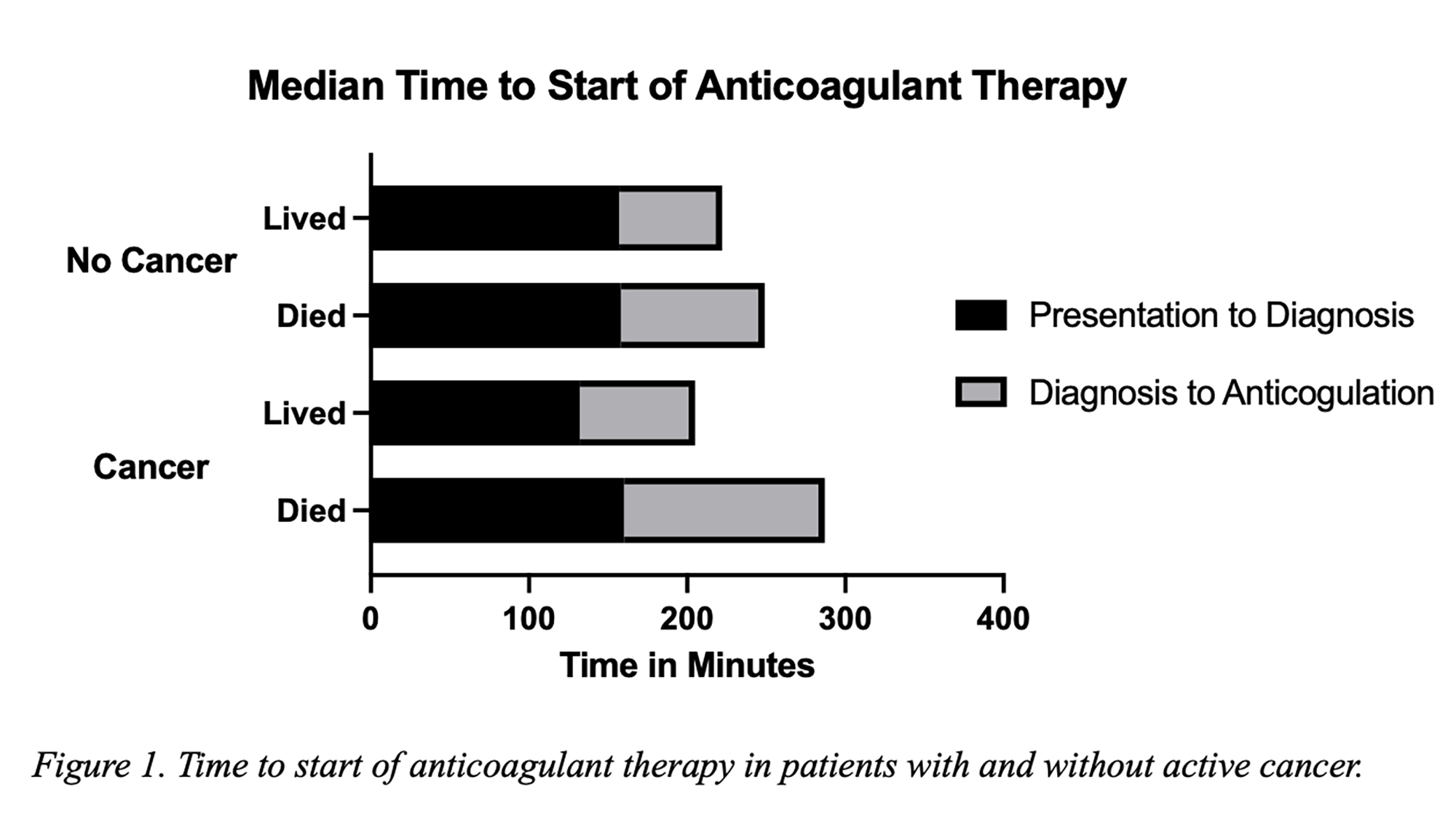
Results. 400 patients met inclusion criteria: 102 patients with active cancer and 298 patients without. Among the patients with cancer, 15 (13.7%) experienced 30-day PE-associated mortality compared to 21 (7.0%) of patients without cancer. The median time to start AT was shorter among patients without cancer (231 minutes) compared to those with cancer (273 minutes) and those who lived (232 minutes) compared to those who died (254 minutes). Among cancer patients, the median time to the start of AT was 259 minutes in patients who lived vs. 304 minutes in those who died. Patients with cancer were diagnosed more quickly with PE (137 minutes) compared to those without (158 minutes). However, they experienced longer delays from PE diagnosis to AT initiation: 75 minutes (cancer) vs. 66 minutes (no cancer). Patients with cancer were more likely to be of older age (69.5 years vs. 62 years), have a lower eGFR (70.5/min vs. 87.8 mL/min), and be thrombocytopenic (30.3% vs. 14.1%).
Conclusions. In patients with intermediate- or high-risk PE, those with active cancer died from a PE-related cause at nearly twice the rate of those without cancer. Despite being diagnosed with PE more quickly, patients with cancer had longer delays in AT initiation, possibly related to comorbidities (i.e., older age, lower eGFR, and thrombocytopenia). Further studies are needed to investigate the optimization of time to AT initiation.

Downloads
Citations




How to Cite

This work is licensed under a Creative Commons Attribution-NonCommercial 4.0 International License.