
OC04 | DIRECT ORAL ANTICOAGULANTS PROVIDE EFFECTIVE THROMBOPROPHYLAXIS IN NEWLY DIAGNOSED MYELOMA: REAL WORLD FINDINGS FROM THE ATOMM STUDY
T. Bull1, Heamstar Collaborators2, W. Wilson3, E. Ganendra4, M. Thomas5, R. Alikhan6, M. Karanth1, M. Camilleri7 | 1West Suffolk Hospital NHS Foundation Trust, UK; 2Haematology Specialty Training Audit and Research HaemSTAR Network, UK; 3University College London Clinical Trial Centre, UK; 4North West Anglia NHS Foundation Trust, UK; 5University College London Hospitals, UK; 6Cardiff and Vale University Health Board, Wales, UK; 7Cambridge University Hospitals NHS Foundation Trust, UK

All claims expressed in this article are solely those of the authors and do not necessarily represent those of their affiliated organizations, or those of the publisher, the editors and the reviewers. Any product that may be evaluated in this article or claim that may be made by its manufacturer is not guaranteed or endorsed by the publisher.
Authors
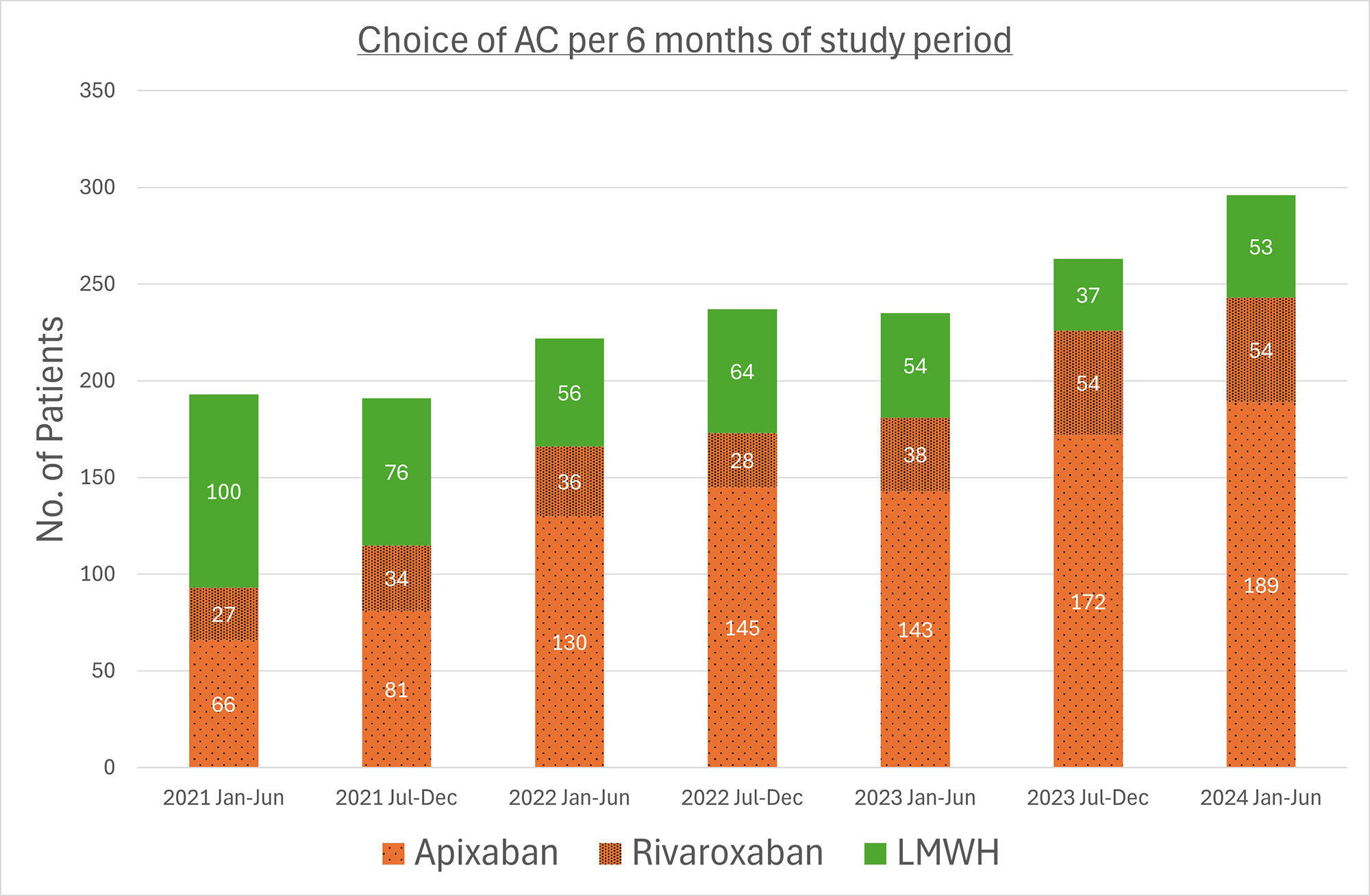
Myeloma is a thrombogenic malignancy with guidelines recommending prophylactic-dose low molecular weight heparin (LMWH) in high thrombosis-risk patients. Evidence supporting anti-factor Xa direct oral anticoagulants (DOACs) is limited. Anticoagulation for ThrOmbosis prevention in Multiple Myeloma (ATOMM) is a UK-wide, retrospective observational study funded by Myeloma UK with HaemSTAR support. ATOMM audited thromboprophylaxis use in the first 6 months of treatment of newly diagnosed myeloma patients against guidelines, collecting thrombosis and bleeding rates. Adult patients starting chemotherapy between 1/1/21 and 1/8/24 were included, excluding those on treatment-dose anticoagulation. Anonymized clinical data from routine records was entered into REDCap. 2,359 patients from 41 centers were included; median age 69 (range 27–100), 58% were male, and 50.1% were transplant-eligible. At presentation, 25.9% had acute kidney injury, 45.6% high-risk cytogenetics, and 78.2% were high-risk for thrombosis (76.2% due to IMiDs and 2% other risks in non-IMiD patients). 1,783 (75.6%) patients received thromboprophylaxis: 69.7% DOAC, 25.2% LMWH, 4.8% aspirin, 0.1% warfarin, and 0.2% unknown. The use of DOACs went up from 51% in 2021 to 79.4% in 2024 (Figure 1). Of 1,798 patients on an IMiD-based regimen, 1,699 (94.4%) received chemical thromboprophylaxis, compared with only 6 of 48 (12.5%) non-IMiD patients at high risk of thrombosis. 75 patients (3.2%) developed thrombosis (60 venous, 15 arterial): 3.1% with prophylaxis vs. 3.5% without. LMWH showed a non-statistically significant trend to higher events vs. DOACs (4.4% vs. 2.7%, p=0.06), likely reflecting patient selection, with tunnelled lines more common in this group (p<0.001). Annual thrombosis rates remained stable despite increased DOAC use: 3.9% (2021), 3.3% (2022), 2.6% (2023), 2.9% (2024). No difference in thrombosis rates was seen between IMiD and non-IMiD regimens (p=0.6). 52 (2.2%) patients developed bleeding (20 major, 26 clinically relevant non-major, and 6 minor), with no significant difference between DOAC and LMWH or between patients with/without thromboprophylaxis (2.5% vs 1.4%, p=0.5). In actual UK patients getting thromboprophylaxis, the rate of thrombosis was 3.1% and the rate of bleeding was 2.5%. Thrombosis rates did not differ significantly between DOAC and LMWH, remaining low and stable despite the shift from LMWH to DOACs. DOACs provide safe and effective thromboprophylaxis in newly diagnosed myeloma.

Downloads
Citations




How to Cite

This work is licensed under a Creative Commons Attribution-NonCommercial 4.0 International License.
Most read articles by the same author(s)
- ICTHIC 2026, PO16 | EPIDEMIOLOGY, CLINICAL CHARACTERISTICS, AND OUTCOMES OF PROVOKED AND UNPROVOKED PULMONARY EMBOLISM IN A MULTICULTURAL ISRAELI POPULATION , Bleeding, Thrombosis and Vascular Biology: Vol. 5 No. s1 (2026)
- ICTHIC 2026, OC12 | RISK OF VENOUS THROMBOEMBOLISM AFTER REMOVAL OF AN UPPER EXTREMITY CENTRAL CATHETER ASSOCIATED WITH A DEEP VEIN THROMBOSIS IN CANCER PATIENTS , Bleeding, Thrombosis and Vascular Biology: Vol. 5 No. s1 (2026)
- ICTHIC 2026, PO04 | FIBRIN CLOT SHIELDS PROMOTE CLONAL SELECTION IN CANCER CELLS: PROCOAGULANT ACTIVITY AND SURVIVAL OF CLOT-EMBEDDED CELLS. A NOVEL TUMOR MICROENVIRONMENT MODEL , Bleeding, Thrombosis and Vascular Biology: Vol. 5 No. s1 (2026)
- ICTHIC 2026, OC13 | VON WILLEBRAND FACTOR PREDICTS POOR OUTCOME IN PANCREATIC CANCER AND MEDIATES TUMOR-ENDOTHELIUM INTERACTIONS FACILITATING METASTASIS , Bleeding, Thrombosis and Vascular Biology: Vol. 5 No. s1 (2026)
- ICTHIC 2026, OC11 | COMPLEXITIES IN MANAGING ANTITHROMBOTIC THERAPY IN PATIENTS WITH CANCER APPROACHING END-OF-LIFE: A MIXED METHOD INTEGRATION USING JOINT DISPLAY ANALYSIS , Bleeding, Thrombosis and Vascular Biology: Vol. 5 No. s1 (2026)
- ICTHIC 2026, PO25 | EVOLUTION OF ANTICOAGULANT STRATEGIES AND CLINICAL OUTCOMES IN CANCER-ASSOCIATED THROMBOSIS: A LONGITUDINAL ANALYSIS OF THE START2 REGISTRY ONCO-VTE , Bleeding, Thrombosis and Vascular Biology: Vol. 5 No. s1 (2026)
- ICTHIC 2026, PO07 | PLATELET INHIBITION BY THE NOVEL NITRIC OXIDE-DONOR NITROSOOXYPROPANOL , Bleeding, Thrombosis and Vascular Biology: Vol. 5 No. s1 (2026)
- ICTHIC 2026, PO34 | INVESTIGATORS’ DECISIONS ON ANTICOAGULATION AFTER EXTENDED API-CAT TREATMENT FOR CANCER VENOUS THROMBOEMBOLISM , Bleeding, Thrombosis and Vascular Biology: Vol. 5 No. s1 (2026)
- ICTHIC 2026, PO22 | LONG-TERM ANTICOAGULANT THERAPY AND REDUCTION OF OVARIAN CANCER RECURRENCE: CLINICAL EVIDENCE OF A POTENTIAL ANTITUMOUR EFFECT , Bleeding, Thrombosis and Vascular Biology: Vol. 5 No. s1 (2026)
- ICTHIC 2026, PO11 | THROMBOEMBOLIC EVENTS DURING PERIOPERATIVE THERAPY FOR RESECTABLE AND BORDERLINE RESECTABLE PANCREATIC CANCER IN THE PREOPANC-2 TRIAL , Bleeding, Thrombosis and Vascular Biology: Vol. 5 No. s1 (2026)