Proceedings of the 13th International Conference on Thrombosis and Hemostasis Issues in Cancer, 2026

Unlocking the potential of statins for venous thromboembolism prophylaxis in cancer: why conduct the STAT-CAT trial?

Publisher's note
All claims expressed in this article are solely those of the authors and do not necessarily represent those of their affiliated organizations, or those of the publisher, the editors and the reviewers. Any product that may be evaluated in this article or claim that may be made by its manufacturer is not guaranteed or endorsed by the publisher.
Published: 16 April 2026
0
Views
0
Downloads

Authors

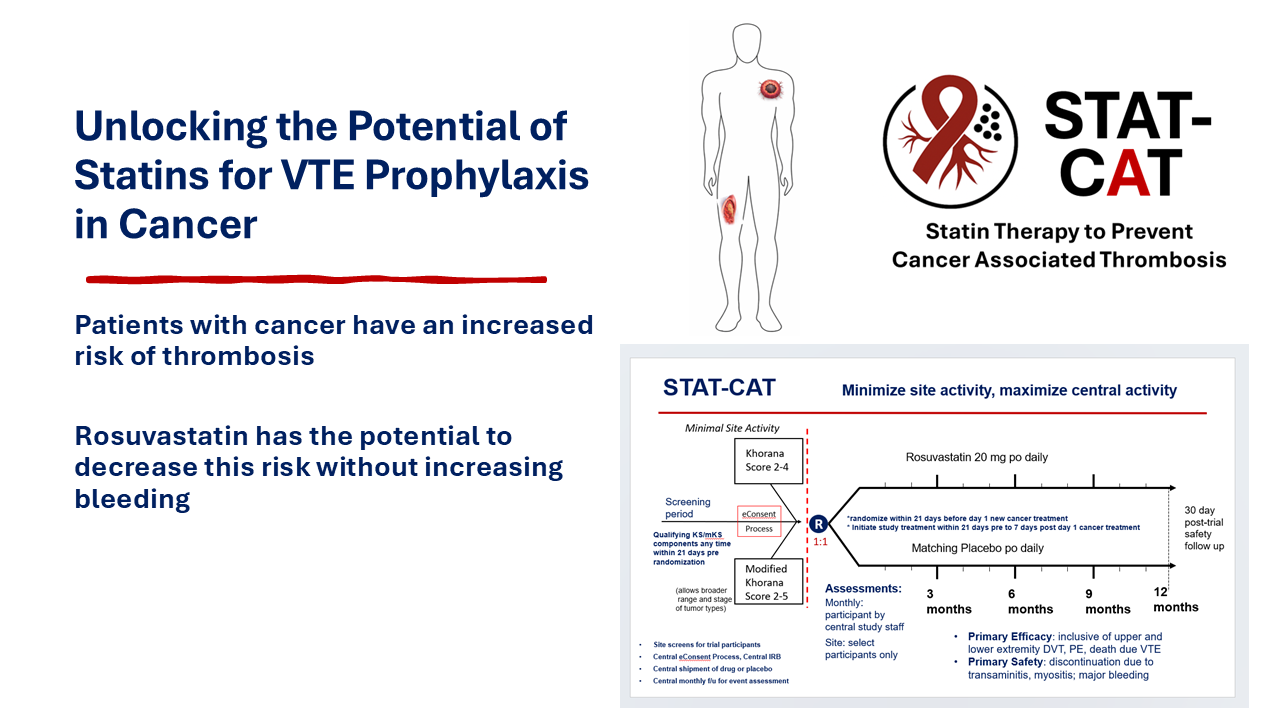
Patients with cancer have an increased risk of venous thromboembolism (VTE), contributing to excess morbidity, mortality, treatment delays, and healthcare utilization. The incidence of cancer-associated VTE has increased over the past two decades. Patients with malignancy now comprise approximately 20% of the global VTE burden. VTE risk is highest during the first 3–6 months after a new or recurrent cancer diagnosis. A new diagnosis of VTE can herald the presence of cancer. Although the risk declines over time, it may not return to baseline for up to two years after cancer treatment in those with no evidence of disease. Randomized trials of prophylactic-dose anticoagulation for primary VTE prevention in ambulatory patients with cancer, including the direct oral anticoagulants, demonstrate a 35–60% reduction in VTE events; however, routine use of primary prophylaxis remains quite limited among patients with cancer due to excessive bleeding risks, which are doubled with most anticoagulants. These competing risks are reflected in conditional guideline recommendations from major societies, which suggest consideration of prophylaxis only in selected high-risk patients with concomitantly low bleeding risks. By contrast, in the general population, statin therapy has been shown to reduce VTE rates by 30 to 40% with no increase in hemorrhage and thus might be a highly effective intervention to reduce the risk of cancer-associated thrombosis. The Statin Therapy to Prevent Cancer-Associated VTE (STAT-CAT) trial, funded by the NHLBI, has been designed to directly test this hypothesis among 4,000 patients initiating cancer therapy. This review summarizes emerging evidence supporting statins as a potential approach to primary VTE prevention in patients with cancer and reviews clinical trials that address statins for VTE risk reduction.

mceclip0-758fb5c98de2167746275937adbe4e9c.jpg
Graphical Abstract

Downloads

Download data is not yet available.

Citations

1. Khorana AA, Mackman N, Falanga A, et al. Cancer-associated venous thromboembolism. Nat Rev Dis Primers 2022;8:11. DOI: https://doi.org/10.1038/s41572-022-00336-y
2. Ay C, Pabinger I, Cohen AT. Cancer-associated venous thromboembolism: Burden, mechanisms, and management. Thromb Haemost 2017;117:219-30. DOI: https://doi.org/10.1160/TH16-08-0615
3. Grilz E, Posch F, Nopp S, et al. Relative risk of arterial and venous thromboembolism in persons with cancer vs. personswithout cancer-a nationwide analysis. Eur Heart J 2021;42:2299-307. DOI: https://doi.org/10.1093/eurheartj/ehab171
4. Mulder FI, Horváth-Puhó E, van Es N, et al. Venous thromboembolism in cancer patients: a population-based cohort study. Blood 2021;137:1959-69. DOI: https://doi.org/10.1182/blood.2020007338
5. Bertoletti L, Madridano O, Jiménez D, et al. Cancer-associated thrombosis: trends in clinical features ,treatment, and outcomes from 2001 to 2020. JACC CardioOncol 2023;5:758-72. DOI: https://doi.org/10.1016/j.jaccao.2023.09.003
6. Li A, La J, May SB, et al. Derivation and validation of a clinical risk assessment model forcancer-associated thrombosis in two unique US health care systems. J Clin Oncol 2023;41:2926-38.
7. Li A, De Las Pozas G, Andersen CR, et al. External validation of a novel electronic risk score for cancer-associated thrombosis in a comprehensive cancer center. Am J Hematol 2023;98:1052-17.
8. Blom JW, Doggen CJ, Osanto S, Rosendaal FR. Malignancies, prothrombotic mutations, and the risk of venous thrombosis. JAMA 2005;293:715-22. DOI: https://doi.org/10.1001/jama.293.6.715
9. Lyman GH. Venous thromboembolism in the patient with cancer: focus on burden of disease and benefits of thromboprophylaxis. Cancer 2011;117:1334-49. DOI: https://doi.org/10.1002/cncr.25714
10. Agnelli G, Gussoni G, Bianchini C, et al. Nadroparin for the prevention of thromboembolic events in ambulatory patients with metastatic or locally advanced solid cancer receiving chemotherapy: a randomised, placebo-controlled, double blind study. Lancet Oncol 2009;10:943-9. DOI: https://doi.org/10.1016/S1470-2045(09)70232-3
11. Agnelli G, George DJ, Kakkar AK, et al. Semuloparin for thromboprophylaxis in patients receiving chemotherapy for cancer. N Engl J Med 2012;366:601-9. DOI: https://doi.org/10.1056/NEJMoa1108898
12. Carrier M, Abou-Nassar K, Mallick R, et al. Apixaban to prevent venous thromboembolism in patients with cancer. N Engl J Med 2019;380:711-9. DOI: https://doi.org/10.1056/NEJMoa1814468
13. Khorana AA, Soff GA, Kakkar AK, et al. Rivaroxaban for thromboprophylaxis in high-risk ambulatory patients with cancer. N Engl J Med 2019;380:720-8. DOI: https://doi.org/10.1056/NEJMoa1814630
14. Li, A, Kuderer, NM, Garcia, DA, et al. Direct oral anticoagulant for the prevention of thrombosis in ambulatory patients with cancer: A systematic review and meta-analysis. J Thromb Haemost 2019;17: 2141-51. DOI: https://doi.org/10.1111/jth.14613
15. Prandoni P, Lensing AW, Piccioli A, et al. Recurrent venous thromboembolism and bleeding complications during anticoagulant treatment in patients with cancer and venous thrombosis. Blood 2002;100:3484-8. DOI: https://doi.org/10.1182/blood-2002-01-0108
16. Angelini DE, Radivoyevitch T, McCrae KR, Khorana AA. Bleeding incidence and risk factors among cancer patients treated with anticoagulation. Am J Hematol 2019;94:780-5. DOI: https://doi.org/10.1002/ajh.25494
17. Lyman GH, Carrier M, Ay C, et al. American Society of Hematology 2021 guidelines for management of venous thromboembolism: prevention and treatment in patients with cancer. Blood Adv 2021;5:927-74. Erratum in: Blood Adv 2021;5:1953. DOI: https://doi.org/10.1182/bloodadvances.2021004734
18. Key NS, Khorana AA, Kuderer NM, et al. Venous thromboembolism prophylaxis and treatment in patients with cancer: ASCO Guideline Update. J Clin Oncol 2023;41:3063-71. DOI: https://doi.org/10.1200/JCO.23.00294
19. Farge D, Frere C, Connors JM, et al. 2022 international clinical practice guidelines for the treatment and prophylaxis of venous thromboembolism in patients with cancer, including patients with COVID-19. Lancet Oncol 2022;23:e334-47.
20. Falanga A, Ay C, Di Nisio M, et al. Venous thromboembolism in cancer patients: ESMO Clinical Practice Guideline. Ann Oncol 2023;34:452-67. DOI: https://doi.org/10.1016/j.annonc.2022.12.014
21. Elshoury A, Schaefer JK, Lim MY, et al. Update on guidelines for the prevention of cancer-associated thrombosis. J Natl Compr Canc Netw 2022;20:7108. DOI: https://doi.org/10.6004/jnccn.2021.7108
22. Ades S, Holmes CE. Implementing guidelines to prevent cancer associated thrombosis: how can we do better? Res Pract Thromb Haemost 2023;7:100038. DOI: https://doi.org/10.1016/j.rpth.2023.100038
23. Khorana AA, Kuderer NM, Culakova E, et al. Development and validation of a predictive model for chemotherapy-associated thrombosis. Blood 2008;111:4902-7. DOI: https://doi.org/10.1182/blood-2007-10-116327
24. Mulder FI, Candeloro M, Kamphuisen PW, et al. The Khorana score for prediction of venous thromboembolism in cancer patients: a systematic review and meta-analysis. Haematologica 2019;104:1277-87. DOI: https://doi.org/10.3324/haematol.2018.209114
25. Cohen AT, Wallenhorst C, Choudhuri S, et al. A novel risk prediction score for clinically significant bleeding in patients anticoagulated for venous thromboembolism with active cancer. Thromb Haemost 2024;124:324-36. DOI: https://doi.org/10.1055/a-2145-7238
26. Holmes CE, Ades S, Gilchrist S, et al. Successful model for guideline implementation to prevent cancer-associated thrombosis: venous thromboembolism prevention in the ambulatory cancer clinic. JCO Oncol Pract 2020;16:e868-74. DOI: https://doi.org/10.1200/JOP.19.00697
27. Butera E, Wang TF, Pola R, Carrier M. Implementation failure: thromboprophylaxis in ambulatory patients with cancer. Hematology Am Soc Hematol Educ Program 2025;2025:72-9. DOI: https://doi.org/10.1182/hematology.2025000689
28. Ridker PM, Danielson E, Fonseca FA, et al. Rosuvastatin to prevent vascular events in men and women with elevated C-reactive protein. N Engl J Med 2008;359:2195-207. DOI: https://doi.org/10.1056/NEJMoa0807646
29. Glynn RJ, Danielson E, Fonseca FA, et al. A randomized trial of rosuvastatin in the prevention of venous thromboembolism. N Engl J Med 2009;360:1851-61. DOI: https://doi.org/10.1056/NEJMoa0900241
30. Yusuf S, Bosch J, Dagenais G, et al. Cholesterol lowering in intermediate-risk persons without cardiovascular disease. N Engl J Med 2016;374:2021-31. DOI: https://doi.org/10.1016/j.jvs.2016.07.054
31. Joseph P, Glynn R, Lonn E, et al. Rosuvastatin for the prevention of venous thromboembolism: a pooled analysis of the HOPE-3 and JUPITER randomized controlled trials. Cardiovasc Res 2022;118:897-903. DOI: https://doi.org/10.1093/cvr/cvab078
32. Zhu H, Zheng H, Xu T, et al. Effects of statins in primary and secondary prevention for venous thromboembolism events: A meta analysis. Vascul Pharmacol 2022;142:106931. DOI: https://doi.org/10.1016/j.vph.2021.106931
33. Lötsch F, Königsbrügge O, Posch F, et al. Statins are associated with low risk of venous thromboembolism in patients with cancer: a prospective and observational cohort study. Thromb Res 2014;134:1008-13. DOI: https://doi.org/10.1016/j.thromres.2014.09.001
34. Khemasuwan D, Divietro ML, Tangdhanakanond K, et al. Statins decrease the occurrence of venous thromboembolism in patients with cancer. Am J Med 2010;123:60-5. DOI: https://doi.org/10.1016/j.amjmed.2009.05.025
35. Setiawan B, Budianto W, Sukarnowati TW, et al. The effectiveness of atorvastatin for the prevention of deep vein thrombosis in cancer patients undergoing chemotherapy: A randomised controlled trial: open label. Thromb J 2023;21:54. DOI: https://doi.org/10.1186/s12959-023-00497-0
36. Ridker PM, Rifai N, Pfeffer MA, et al. Inflammation, pravastatin, and the risk of coronary events after myocardial infarction in patients with average cholesterol levels. Circulation 1998;98:839-44. DOI: https://doi.org/10.1161/01.CIR.98.9.839
37. Delvaeye M, Conway EM. Coagulation and innate immune responses: can we view them separately? Blood 2009;114:2367-74. DOI: https://doi.org/10.1182/blood-2009-05-199208
38. Mylonas KS, Peroulis M, Schizas D, Kapelouzou A. MYD88 and proinflammatory chemokines in aortic atheromatosis: exploring novel statin effects. Int J Mol Sci 2023;24:9248. DOI: https://doi.org/10.3390/ijms24119248
39. Kleemann R, Princen HM, Emeis JJ, et al. Rosuvastatin reduces atherosclerosis development beyond and independent of its plasma cholesterol-lowering effect in APOE*3-Leiden transgenic mice: evidence for antiinflammatory effects of rosuvastatin. Circulation 2003;108:1368-74. DOI: https://doi.org/10.1161/01.CIR.0000086460.55494.AF
40. Siniscalchi C, Basaglia M, Riva M, et al. Statins effects on blood clotting: a review. Cells 2023;12:2719. DOI: https://doi.org/10.3390/cells12232719
41. Biedermann JS, Kruip MJHA, van der Meer FJ, et al. Rosuvastatin use improves measures of coagulation in patients with venous thrombosis. Eur Heart J 2018;39:1740-7. DOI: https://doi.org/10.1093/eurheartj/ehy014
42. Orsi FA, Biedermann JS, Kruip MJHA, et al. Rosuvastatin use reduces thrombin generation potential in patients with venous thromboembolism: a randomized controlled trial. J Thromb Haemost 2019;17:319-28. DOI: https://doi.org/10.1111/jth.14364
43. Camilleri E, van Rein N, van Vlijmen BJM, et al. Influence of rosuvastatin on apolipoproteins and coagulation factor levels: Results from the STAtin Reduce Thrombophilia trial. Res Pract Thromb Haemost 2023;7:100063. DOI: https://doi.org/10.1016/j.rpth.2023.100063
44. Chou TC, Lin YF, Wu WC, Chu KM. Enhanced nitric oxide and cyclic GMP formation plays a role in the antiplatelet activity of simvastatin. Br J Pharmacol 2008;153:1281-7. DOI: https://doi.org/10.1038/bjp.2008.19
45. Pignatelli P, Carnevale R, Pastori D, et al. Immediate antioxidant and antiplatelet effect of atorvastatin via inhibition of Nox2. Circulation 2012;126:92-103. DOI: https://doi.org/10.1161/CIRCULATIONAHA.112.095554
46. Puccetti L, Santilli F, Pasqui AL, et al. Effects of atorvastatin and rosuvastatin on thromboxane-dependent platelet activation and oxidative stress in hypercholesterolemia. Atherosclerosis 2011;214:122-8. DOI: https://doi.org/10.1016/j.atherosclerosis.2010.10.006
47. Serebruany VL, Miller M, Pokov AN, et al. Effect of statins on platelet PAR-1 thrombin receptor in patients with the metabolic syndrome (from the PAR-1 inhibition by statins [PARIS] study). Am J Cardiol 2006;97:1332-6. DOI: https://doi.org/10.1016/j.amjcard.2005.11.058
48. Vadivel K, Bajaj SP. Structural biology of factor VIIa/tissue factor initiated coagulation. Front Biosci (Landmark Ed) 2012;17:2476-94. DOI: https://doi.org/10.2741/4066
49. Newman CB, Preiss D, Tobert JA, et al. Statin safety and associated adverse events: a scientific statement from the American Heart Association. Arterioscler Thromb Vasc Biol 2019;39:e38-e81. DOI: https://doi.org/10.1161/ATV.0000000000000081
50. Villani R, Navarese EP, Cavallone F, et al. Risk of statin-induced hypertransaminasemia: a systematic review and meta-analysis of randomized controlled trials. Mayo Clin Proc Innov Qual Outcomes 2019;3:131-40. DOI: https://doi.org/10.1016/j.mayocpiqo.2019.01.003
51. Shepherd J, Vidt DG, Miller E, et al. Safety of rosuvastatin: update on 16,876 rosuvastatin-treated patients in a multinational clinical trial program. Cardiology 2007;107:433-43 DOI: https://doi.org/10.1159/000100908
52. Cholesterol Treatment Trialists' (CTT) Collaboration. Assessment of adverse effects attributed to statin therapy in product labels: a meta-analysis of double-blind randomised controlled trials. Lancet 2026;407:689-703.
53. Cholesterol Treatment Trialists' Collaboration. Effect of statin therapy on muscle symptoms: an individual participant data meta-analysis of large-scale, randomised, double-blind trials. Lancet 2022;400:832-45. Erratum in: Lancet 2022;400:1194.
54. Mei Z, Liang M, Li L, et al. Effects of statins on cancer mortality and progression: a systematic review and meta-analysis of 95 cohorts including 1,111,407 individuals. Int J Cancer 2017;140:1068–1081. doi: 10.1002/ijc.30526. PMID: 27859151. DOI: https://doi.org/10.1002/ijc.30526
55. Thomas JP, Loke YK, Alexandre L. Efficacy and safety profile of statins in patients with cancer: a systematic review of randomised controlled trials. Eur J Clin Pharmacol 2020;76:1639-51. DOI: https://doi.org/10.1007/s00228-020-02967-0
56. Bikdeli B, Tajrishi FZ, Connors JM. Risk of myopathy and hepatotoxicity in patients with cancer receiving statin therapy: Systematic review of randomized controlled trials. Vasc Med 2024;29:556-8. DOI: https://doi.org/10.1177/1358863X241246471
57. Caiano LM, Drury T, Zahrai A, et al. Role of statins in the prevention of post-thrombotic syndrome after a deep vein thrombosis event: a systematic review and meta-analysis. J Thromb Haemost 2023;21:944-52. DOI: https://doi.org/10.1016/j.jtha.2022.12.008
58. Delluc A, Ghanima W, Kovacs MJ, et al. Prevention of post-thrombotic syndrome with rosuvastatin: A multicenter randomized controlled pilot trial (SAVER). Thromb Res 2022;213:119-24. DOI: https://doi.org/10.1016/j.thromres.2022.03.014
59. Li A, La J, May SB, et al. Derivation and validation of a clinical risk assessment model for cancer-associated thrombosis in two unique US health care systems. J Clin Oncol 2023;41:2926-38. DOI: https://doi.org/10.1200/JCO.22.01542
60. Li A, De Las Pozas G, Andersen CR, et al. External validation of a novel electronic risk score for cancer-associated thrombosis in a comprehensive cancer center Am J Hematol 2023;98:1052-7. DOI: https://doi.org/10.1002/ajh.26928

Supporting Agencies

STAT-CAT is funded through NHLBI grant UG3HL176627

How to Cite


1.
Connors JM, Glynn RJ, Khorana AA, Ridker PM. Unlocking the potential of statins for venous thromboembolism prophylaxis in cancer: why conduct the STAT-CAT trial?. Bleeding Thromb Vasc Biol [Internet]. 2026 Apr. 16 [cited 2026 Apr. 17];5(s1). Available from: https://www.btvb.org/btvb/article/view/450