
PO09 | CANCER MORTALITY AFTER INCIDENT VENOUS THROMBOEMBOLISM
C. Langholm1, N.H. Eide1, K. Hveem2|3|4, N. Van Es5|6, V.M. Morelli1|7, S.K. Braekkan1|7, J.B. Hansen1|7 | 1Thrombosis Research Group, Department of Clinical Medicine, UiT – The Arctic University of Norway, Tromsø, Norway; 2HUNT Research Centre, Department of Public Health and General Practice, Norwegian University of Science and Technology, Levanger, Norway; 3HUNT Center for Molecular and Clinical Epidemiology, Department of Public Health and Nursing, Norwegian University of Science and Technology, Trondheim, Norway; 4Department of Research, St. Olav University Hospital, Trondheim, Norway; 5Department of Vascular Medicine, Amsterdam UMC, University of Amsterdam, Amsterdam, the Netherlands; 6Amsterdam Cardiovascular Sciences Pulmonary Hypertension and Thrombosis Amsterdam, the Netherlands; 7Thrombosis Research Center, Department of Internal Medicine, University Hospital of North Norway, Tromsø, Norway

All claims expressed in this article are solely those of the authors and do not necessarily represent those of their affiliated organizations, or those of the publisher, the editors and the reviewers. Any product that may be evaluated in this article or claim that may be made by its manufacturer is not guaranteed or endorsed by the publisher.
Authors
Introduction. Previous studies have shown a poor prognosis in venous thromboembolism (VTE) patients with occult cancer (i.e., cancer < 1 year after VTE). The prognosis in VTE patients diagnosed with cancer >1 year after VTE is less studied. Whether advances in management and treatment of both VTE and cancer during the last decades have contributed to improving survival in patients with occult cancer-related VTE remains unsettled.
Aims. The aim of this study is to assess mortality in patients diagnosed with cancer within one year and more than one year after a VTE, compared with cancer patients without prior VTE, and to explore whether these estimates changed during two time periods: 1994-2007 and 2008-2020.
Materials and Methods. A cohort of participants diagnosed with cancer (n = 15,457) was derived from the Tromsø4-7 and HUNT2-3 surveys with follow-up in the period 1994-2020. We estimated cumulative incidences and hazard ratios (HRs) with 95% confidence intervals (CIs) for all-cause mortality in patients with cancer ≤1 year (n=135) and >1 year after VTE (n=250) compared with cancer patients without prior VTE (n=15,072). Separate analyses were performed for the periods 1994-2007 and 2008-2020.
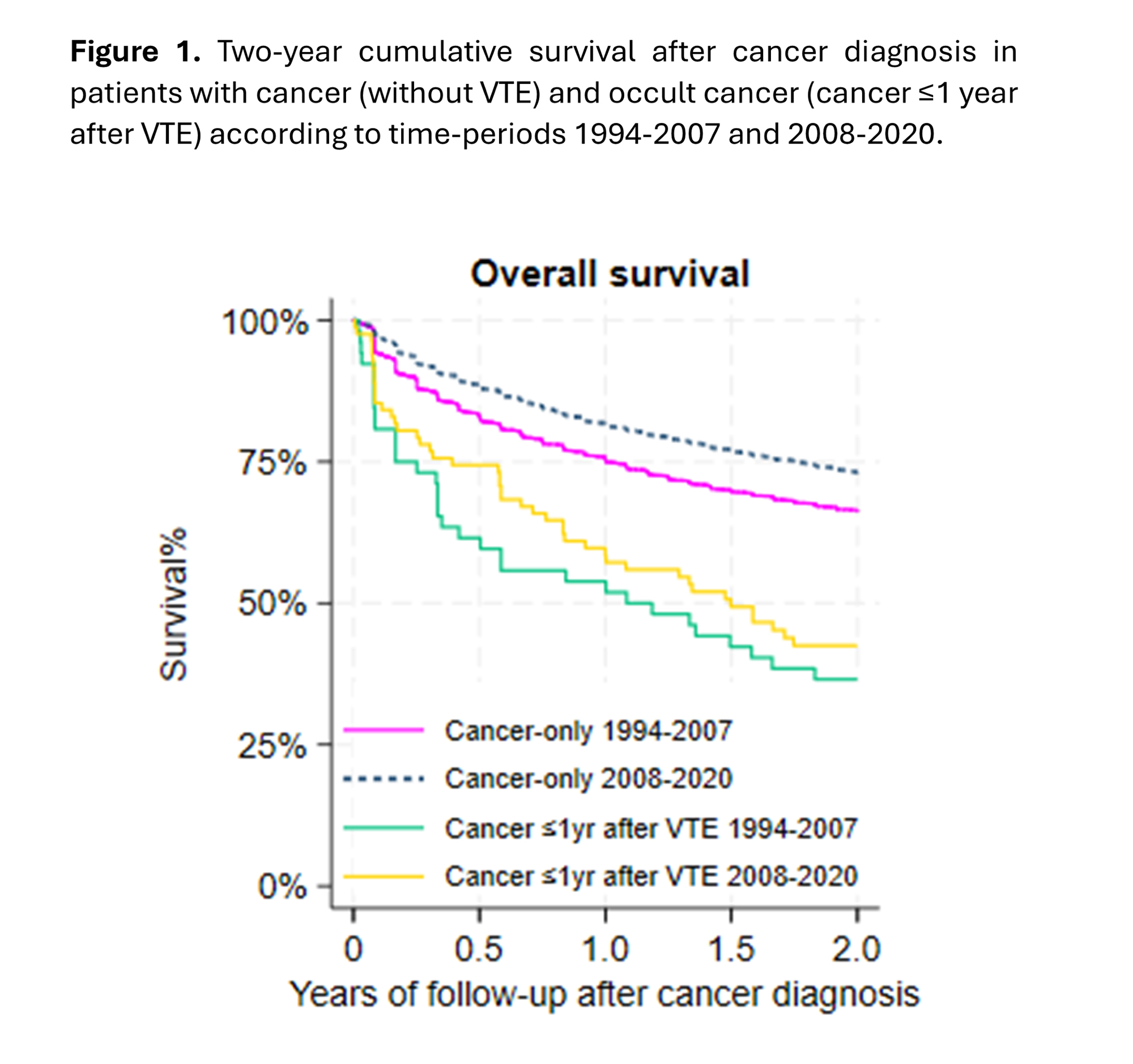
Results. The 1-year survival after cancer diagnosis was 56.7% and 66.6% among those with cancer ≤1 year and >1 year after VTE, respectively, and 78.8% in cancer patients without prior VTE. The corresponding 1-year age- and sex-adjusted HRs of mortality were 2.29 (95% CI: 1.76-2.98) and 1.24 (95% CI: 0.98-1.56) for cancer ≤1 year and >1 year after VTE, respectively. Adjustment for cancer type and stage substantially attenuated the mortality HR for patients diagnosed with cancer ≤1 year after VTE (HR 1.19, 95% CI: 0.90–1.55). The survival of these patients improved slightly from 1994-2007 to 2008-2020, reflecting the overall trend in improved survival among cancer patients (Figure 1).
Conclusions. Patients with cancer ≤1 year after VTE had a >2-fold increased mortality risk, which was mainly driven by aggressive cancer types and advanced stage at cancer diagnosis. The survival of these patients improved slightly from 1994-2007 to 2008-2020. Recent advancements in the diagnostics and treatment of cancer, along with increased awareness of occult cancer in patients with VTE, might have improved the mortality risk in patients diagnosed with cancer ≤1 year after incident VTE.

Downloads
Citations




How to Cite

This work is licensed under a Creative Commons Attribution-NonCommercial 4.0 International License.
Most read articles by the same author(s)
- ICTHIC 2026, PO38 | PERICATHETER AND SYSTEMIC THROMBOSIS DURING CAR-T LYMPHOCYTAPHERESIS: INCIDENCE AND CLINICAL CORRELATES , Bleeding, Thrombosis and Vascular Biology: Vol. 5 No. s1 (2026)
- ICTHIC 2026, PO49 | PROPHYLACTIC ANTICOAGULATION DECISIONS IN HIGH-RISK PATIENTS RECEIVING CANCER-DIRECTED THERAPY: ANALYSIS OF THE VERMONT METHOD , Bleeding, Thrombosis and Vascular Biology: Vol. 5 No. s1 (2026)
- ICTHIC 2026, PO08 | NEXT-GENERATION THROMBOLYTICS: ENGINEERING STREPTOKINASE FOR ENHANCED ACTIVITY AND REDUCED IMMUNOGENICITY , Bleeding, Thrombosis and Vascular Biology: Vol. 5 No. s1 (2026)
- ICTHIC 2026, PO19 | THE INTER-RELATIONSHIP BETWEEN NETOSIS, THE ADAMTS-13/VWF AXIS, AND HEMOSTATIC ACTIVATION IN PATIENTS WITH GYNECOLOGICAL MALIGNANCIES: PROGNOSTIC SIGNIFICANCE AND IMPACT OF CHEMOTHERAPY , Bleeding, Thrombosis and Vascular Biology: Vol. 5 No. s1 (2026)
- ICTHIC 2026, PO02 | SYNERGISTIC INTERACTION OF ENDOTHELIAL AND CANCER CELLS IN THE FORMATION AND STRUCTURE OF THE FIBRIN CLOT SHIELDS , Bleeding, Thrombosis and Vascular Biology: Vol. 5 No. s1 (2026)
- ICTHIC 2026, PO37 | CLINICAL SIGNIFICANCE OF SYMPTOMATIC AND INCIDENTAL VENOUS THROMBOEMBOLISM IN CANCER PATIENTS TREATED WITH APIXABAN , Bleeding, Thrombosis and Vascular Biology: Vol. 5 No. s1 (2026)
- ICTHIC 2026, PO64 | MANAGEMENT OF BLEEDING RISK IN PATIENTS WITH HEPATOCELLULAR CARCINOMA RECEIVING SYSTEMIC THERAPY: A SURVEY OF CLINICAL PRACTICE , Bleeding, Thrombosis and Vascular Biology: Vol. 5 No. s1 (2026)
- ICTHIC 2026, OC10 | FROM DESIGN TO CLINICAL PHASE 3 IN ONCOLOGY: CD13-TARGETED TISSUE FACTOR AND TUMOR INFARCTION , Bleeding, Thrombosis and Vascular Biology: Vol. 5 No. s1 (2026)
- ICTHIC 2026, PO69 | INCIDENTAL CANCER DETECTED DURING EMERGENCY DIAGNOSTIC WORK-UP FOR ACUTE PULMONARY EMBOLISM: A RETROSPECTIVE COHORT STUDY , Bleeding, Thrombosis and Vascular Biology: Vol. 5 No. s1 (2026)
- ICTHIC 2026, PO21 | PSYCHOLOGICAL IMPACT OF CANCER-ASSOCIATED THROMBOSIS: DUAL BURDEN AND IMPLICATIONS FOR QUALITY OF LIFE AND INTEGRATED PATIENT-CENTERED CARE , Bleeding, Thrombosis and Vascular Biology: Vol. 5 No. s1 (2026)